
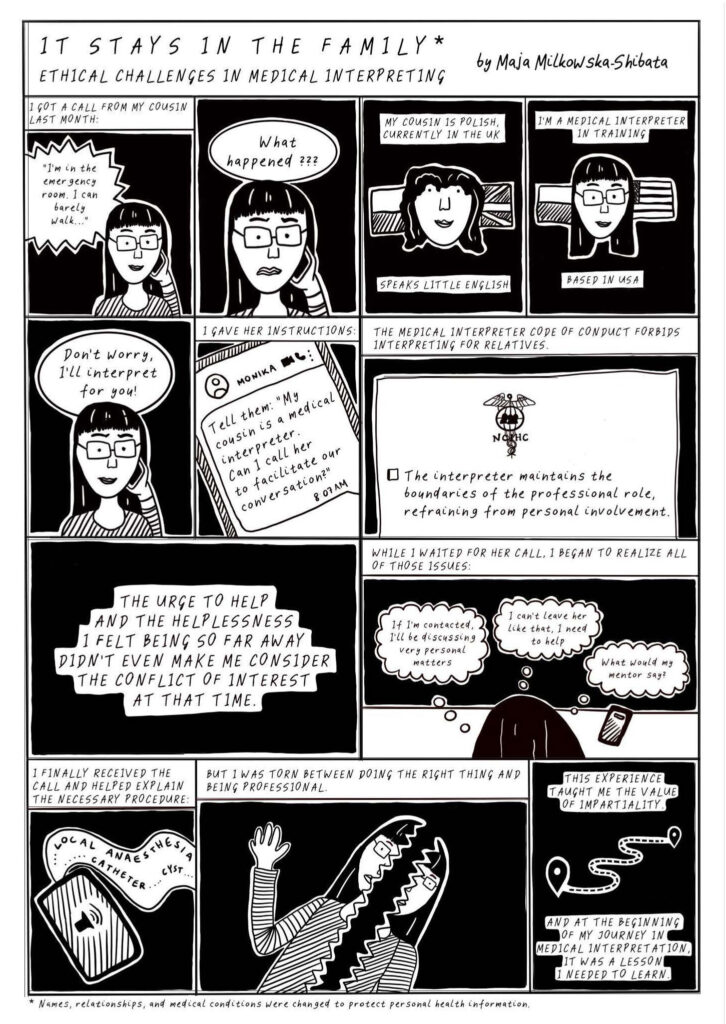
Access this comic as a PDF or read below.
Comic Takeaways
- Through their unique positionality, medical interpreters can challenge conventional communication and power dynamics between members of the healthcare team and patients with limited language proficiency.
- The pragmatic and ethical dimensions of medical interpreters’ “translation moments” (Gonzales & Bloom-Pojar, 2018) can be complicated by their layered and multiple relationships to other
stakeholders. - Professional standards of practice ensure that medical interpreters adhere to the meaning and context of the information being conveyed. This comic demonstrates the risks of compromising such standards by showing how, for example, interpreting for family members can alter the meaning and flow of communication.
- Comics can provide healthcare practitioners a useful means of identifying and preparing for communication- and relationship-based ethico-professional challenges, also offering rhetoricians of health and medicine an alternative discourse for understanding the rhetorical dimensions of such challenges.
Artist Statement
The comic was created to raise awareness of the work of medical interpreters and the challenges they face in their daily interactions with patients and healthcare providers. It depicts a specific dilemma concerning the importance of impartiality that may arise during medical interpretation.
Medical interpreters must disclose conflicts of interest and withdraw, if necessary, such as when interpreting for relatives and acquaintances, because not doing so jeopardizes values such as accuracy, confidentiality, and role boundaries.
The comic highlights the role of medical interpreters as communication mediators and encourages discussion about how taking on this role may affect the intended meaning of the exchanged message. Describing a real-world experience of a practitioner, the comic provides material for further analysis for scholars engaged in research within the rhetoric of health and medicine (RHM) who study power relationships in healthcare settings.
The comic was inspired, in part, by “A Dialogue with Medical Interpreters About Rhetoric, Culture, and Language,” co-authored by Laura Gonzales and Rachel Bloom-Pojar (2018). Similarly, it touches on multilingual discourse in RHM scholarship and practice.
The visual style of the comic was influenced by MariNaomi’s memoir, Turning Japanese. Clean and simple black and white illustrations were employed to keep readers’ attention on the meaning of the story being told.
It is my hope that “It Stays in the Family” is the first in a series of comics aimed at bringing the work of medical interpreters to a wider audience, through presentations at the Graphic Medicine Conference and my website of www.majamilkowska-shibata.com.
The comic was created digitally in Procreate to ensure high resolution drawings. Prior to drawing, a script outlining the panels and accompanying text was developed, following the approach described in Meredith Li-Vollmer’s Graphic Public Health (2022).
References
Gonzales, Laura, & Bloom-Pojar, Rachel. (2018). A dialogue with medical interpreters about rhetoric, culture, and language. Rhetoric of Health & Medicine, 1(1-2), 193-212.
Li-Vollmer, Meredith. (2022). Graphic public health: A comics anthology and road map. Penn State University Press.
MariNaomi. (2016). Turning Japanese: A graphic memoir (illustrated edition). 2dcloud.
Click on an image below to open a larger version.
Author Bio
Maja Milkowska-Shibata (she/her) is a visual storyteller, independent researcher, and medical interpreter based in Naperville, IL, USA. Her comics have been featured in Sequential Artists Workshop Anthologies (2023, 2024), Intima (2024), and Tendon (2025). She is currently developing a long-form graphic memoir.
To Cite
Milkowska-Shibata, Maja. (2023). It stays in the family [comic and artist statement]. Rhetoric of Health & Medicine, 6(4), http://medicalrhetoric.com/graphicRHM/home/archive/column-1/milkowska-shibata/