Introduction for Column One

Click on an image below to open a larger version, or read as a PDF.

Comic Takeaways

  • Introducing Graphic RHM: The co-editors present Graphic RHM both as a recurring journal column and as a broader scholarly and creative practice.
  • Highlighting Themes: The comic showcases key themes and examples from the column, emphasizing how comics can advance research and pedagogy in rhetoric of health and medicine.
  • Inviting Collaboration: Readers are invited to contribute to the growing conversation by engaging with, teaching, and creating Graphic RHM work.
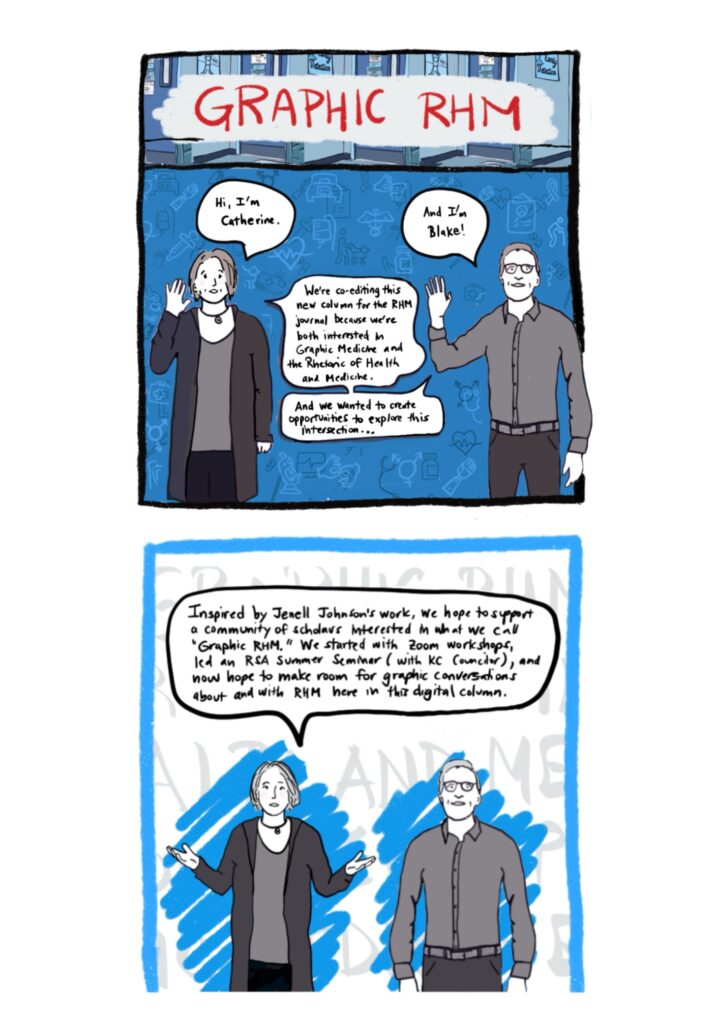
Panel 1 Image: Catherine (white woman) and Blake (white man) standing, waving hello, and introducing ourselves and the Graphic RHM column, with various medical images—such as a clipboard, pills, stethoscope, prosthetic limb, person with assistance dog, IV drip, and more—floating in background. (We will see these background images again throughout the introduction.) Text: Hi, I’m Catherine. And I’m Blake. We’re co-editing this new column for the RHM journal because we’re both interested in Graphic Medicine and the Rhetoric of Health and Medicine. And we wanted to create opportunities to explore this intersection. Panel 2 Image: Catherine and Blake standing and facing reader, with Catherine’s arms out in an explanatory pose. There are bright blue scribbles that make the greyscale images of Blake and Catherine stand out. There are also large greyed-out words on a white background that give texture to the image but are not fully legible because Blake and Catherine are in front of them; they would say “GRAPHIC MEDICINE THE RHETORIC OF HEALTH AND MEDICINE” if you could see them fully. Text: Inspired by Jenell Johnson’s work, we hope to support a community of scholars interested in what we call “Graphic RHM.” We started with Zoom workshops, lead an RSA Summer Seminar (w KC Councilor), and now hope to make room for graphic conversations about and with RHM here in this digital column.
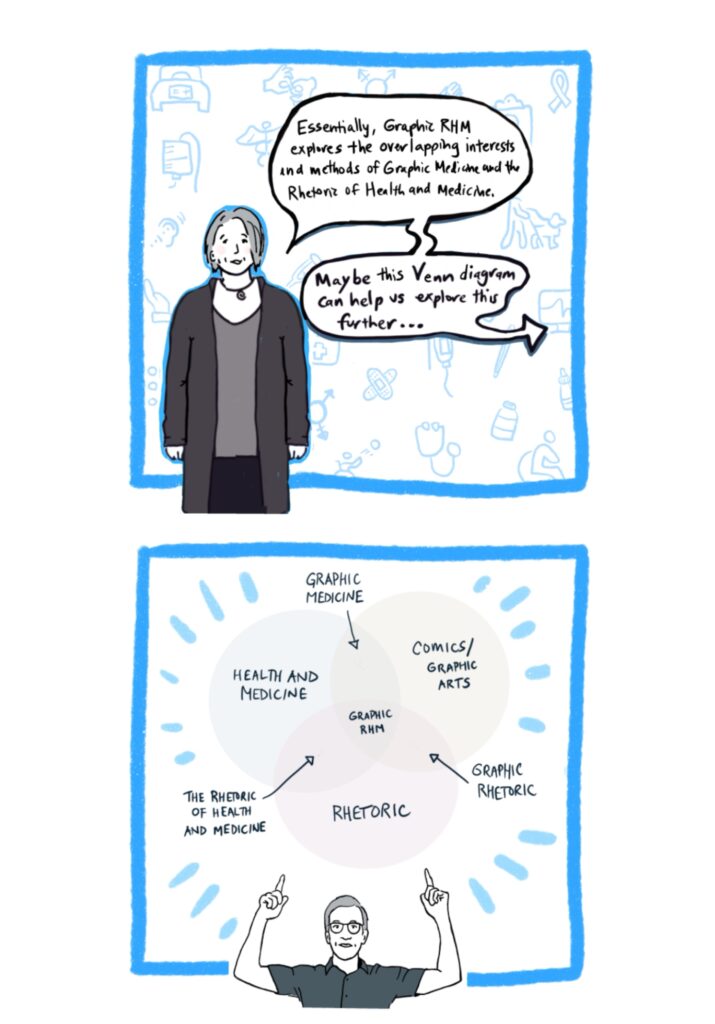
Panel 3 Image: Catherine standing and facing reader, with various medical images—such as a clipboard, pills, stethoscope, prosthetic limb, person with assistance dog, IV drip, and more—floating in the background. Text: Essentially, Graphic RHM explores the overlapping interests and methods of Graphic Medicine and the Rhetoric of Health and Medicine. Maybe this Venn diagram can help us explore this further… Panel 4 Image: Blake at bottom middle of frame pointing up with both hands to Venn diagram of Graphic RHM at the center of Health and Medicine, Rhetoric, and Comics/Graphic Arts. At the intersection of Health and Medicine and Comics/Graphic Arts is Graphic Medicine. At the intersection of Health and Medicine and Rhetoric is The Rhetoric of Health and Medicine. At the intersection of Rhetoric and Comics/Graphic Arts is Graphic Rhetoric.
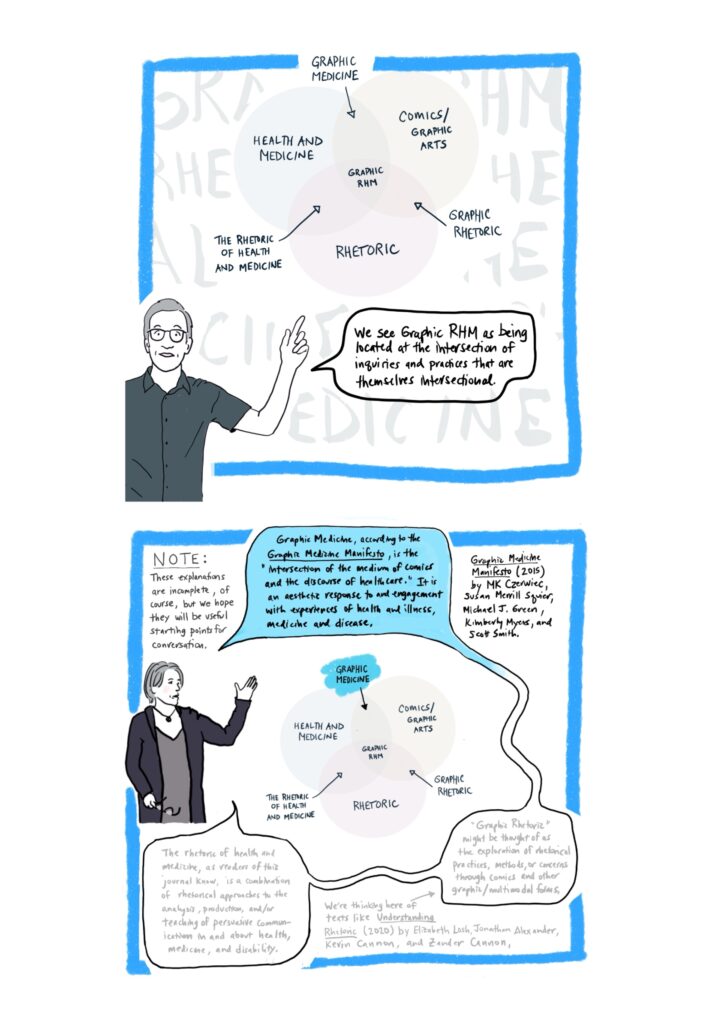
Panel 5 Image: Blake at bottom left of frame pointing with one hand to smaller version of Graphic RHM Venn diagram. There are large greyed-out words on a white background that give texture to the image but are not fully legible because Blake is in front of them; they would say “GRAPHIC MEDICINE THE RHETORC OF HEALTH AND MEDICINE” if you could see them fully. Text: We see Graphic RHM as being located at the intersection of other areas of inquiry and practice that are themselves intersectional. Panel 6 Image: Catherine at left of frame, holding her glasses and with one hand up in the direction of the Venn diagram, which has a note (top left) and Graphic Medicine highlighted, and explaining the intersection. Text: NOTE: These explanations of incomplete, of course, but we hope they will be useful starting points for conversation. Graphic Medicine, according to the Graphic Medicine Manifesto (2015, edited by Mk Czerwiec, Ian Williams, Susan Merrill Squier, Michael J. Green, Kimberly J. Meyers, and Scott T. Smith), is the “intersection of the medium of comics and the discourse of healthcare.” It is an aesthetic response to and engagement with experiences of health, illness, and disability.
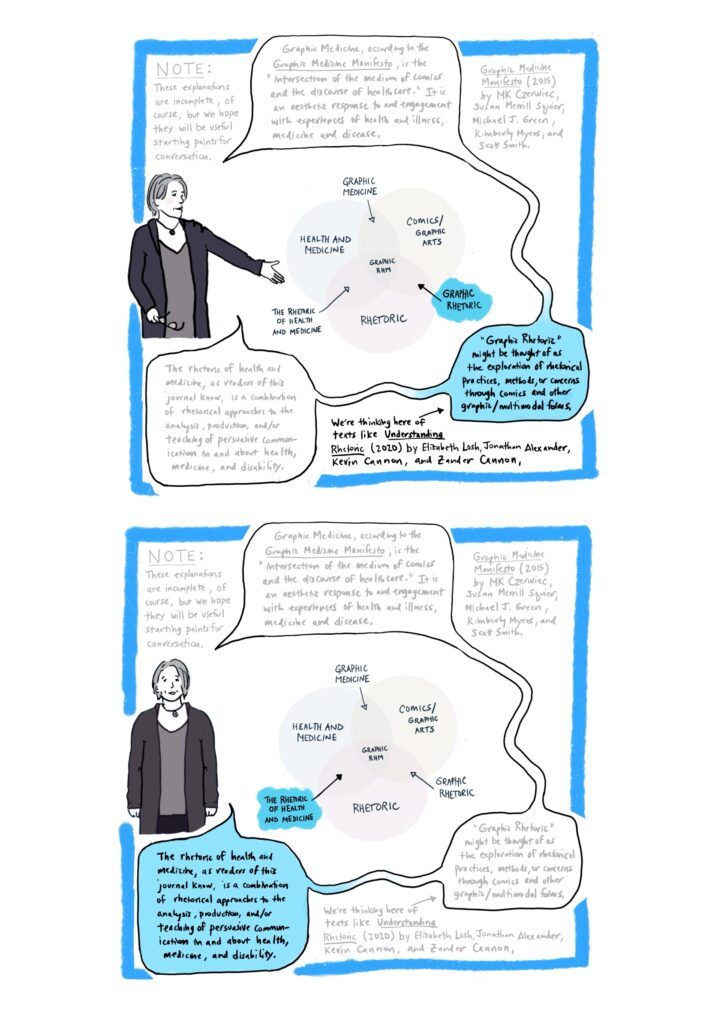
Panel 7 Image: Catherine at left of frame, holding her glasses and with one hand pointing down in the direction of the lower part of the Venn diagram, which has Graphic Rhetoric highlighted, and explaining the intersection. Text: “Graphic Rhetoric” might be thought of as the exploration of rhetorical practices, methods, or concerns through comics and other graphic/multimodal forms. We’re thinking here of texts like Understanding Rhetoric (2020) by Elizabeth Losh, Jonathan Alexander, Kevin Cannon, and Zander Cannon. Panel 8 Image: Catherine at left of frame, facing the reader. The Rhetoric of Health and Medicine is highlighted and there is an explanation of the intersection. Text: The Rhetoric of Health and Medicine, as readers of this journal know, is a combination of rhetorical approaches to the analysis, production, and/or teaching of persuasive communication in and about health, medicine, and disability.
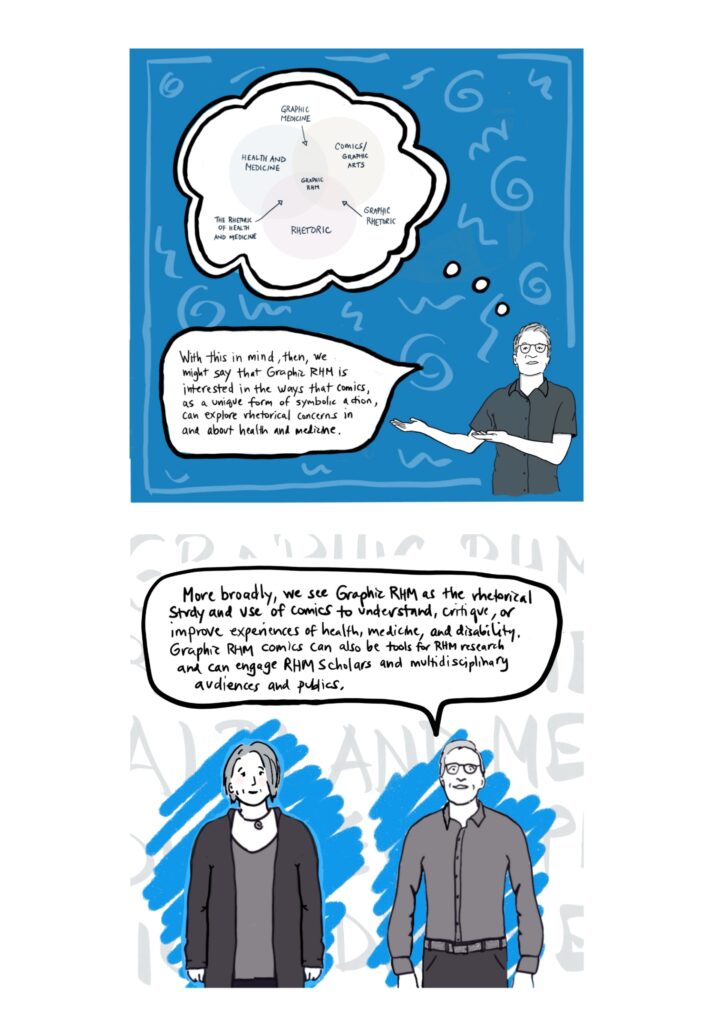
Panel 9 Image: Blake at bottom right of frame, with both arms pointing to explanation and Venn diagram to the left. Background is blue and has some lighter blue squiggle lines on it. Text: With this in mind, then, we might say that Graphic RHM is interested in the ways that comics, as a unique form of symbolic action, can explore rhetorical concerns related to health and medicine. Panel 10 Image: Catherine and Blake standing and facing reader, with arms down and Blake speaking. There are bright blue scribbles that make the greyscale images of Blake and Catherine stand out. There are also large greyed-out words on a white background that give texture to the image but are not fully legible because Blake and Catherine are in front of them; they would say “GRAPHIC MEDICINE THE RHETORC OF HEALTH AND MEDICINE” if you could see them fully. Text: More broadly, we see Graphic RHM as the rhetorical study and use of comics to understand, critique, or improve experiences of health, medicine, and disability. Graphic RHMC comics can also be tools for RHM research and can engage RHM scholars and multidisciplinary audiences and publics.
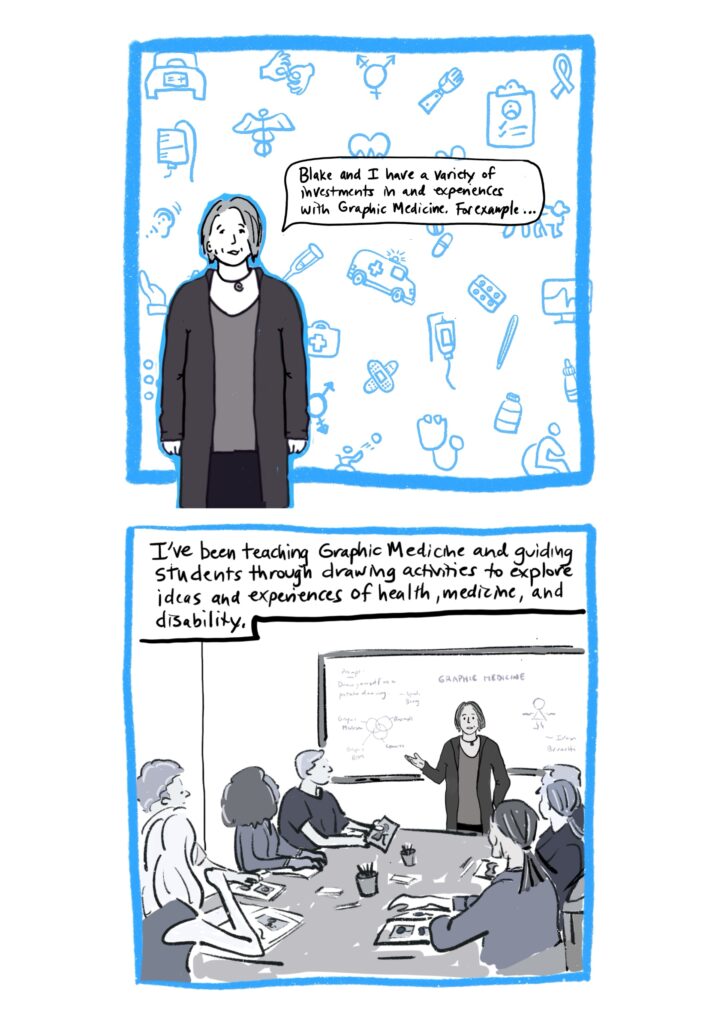
Panel 11 Image: Catherine standing at left of frame and speaking, with lots of blue medical images—such as a clipboard, pills, stethoscope, prosthetic limb, person with assistance dog, IV drip, and more— floating in the background. Text: Blake and I have various experiences with Graphic RHM. Panel 12 Image: Catherine standing in classroom in front on white board, explaining ideas about Graphic Medicine on the board. Seven students of apparently different ages, genders, and ethnicities are sitting on both sides of a long table with various drawing supplies, looking up at Catherine. Text: I’ve been teaching Graphic Medicine and having students draw to explore both their ideas about and their experiences of health, medicine, and disability.
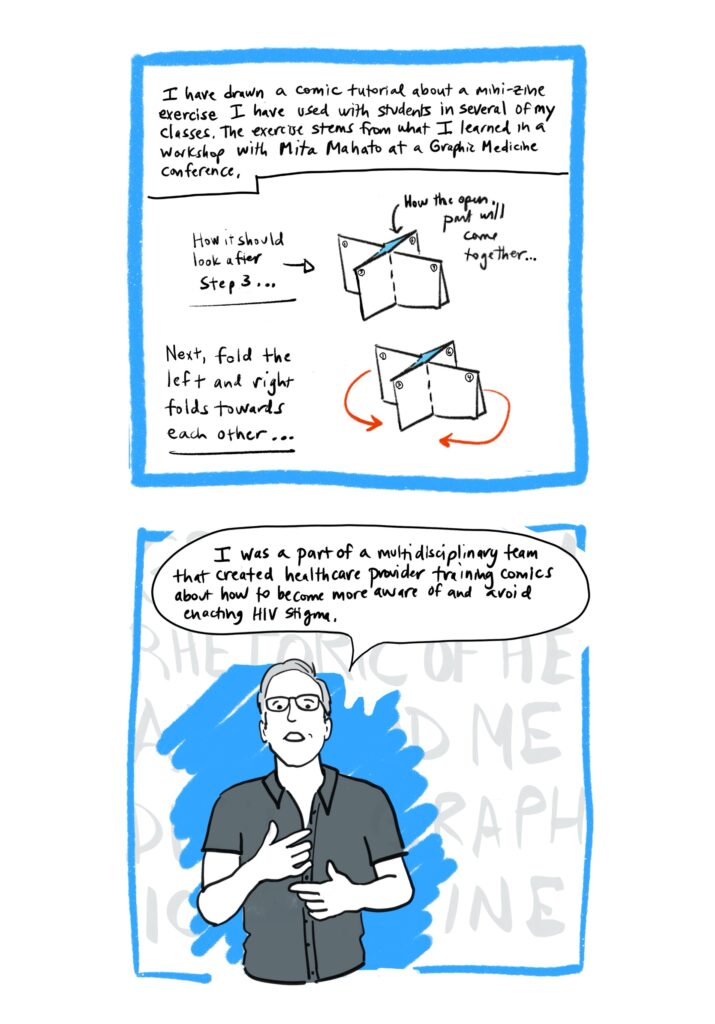
Panel 13 Image: Diagrams showing papers being folded into eight frames to form a mini zine, with written directions, such as “How it should look after step three.” Text: I have drawn a comic tutorial about a mini-zine exercise I have used with students in several of my classes. The exercise stems from what I learned in a workshop with Mita Mahato at a Graphic Medicine conference. How it should look after Step 3…How the open part will come together…Next, fold the left and right folds towards each other… Panel 14 Image: Blake standing and speaking with arms in explanatory mode. There are bright blue scribbles that make the greyscale image of Blake stand out. There are also large greyed-out words on a white background that give texture to the image but are not fully legible because Blake is in front of them; they would say “GRAPHIC MEDICINE THE RHETORIC OF HEALTH AND MEDICINE” if you could see them fully. Text: I was part of a team that created health care provider training comics about how to be more aware of and avoid enacting HIV stigma.
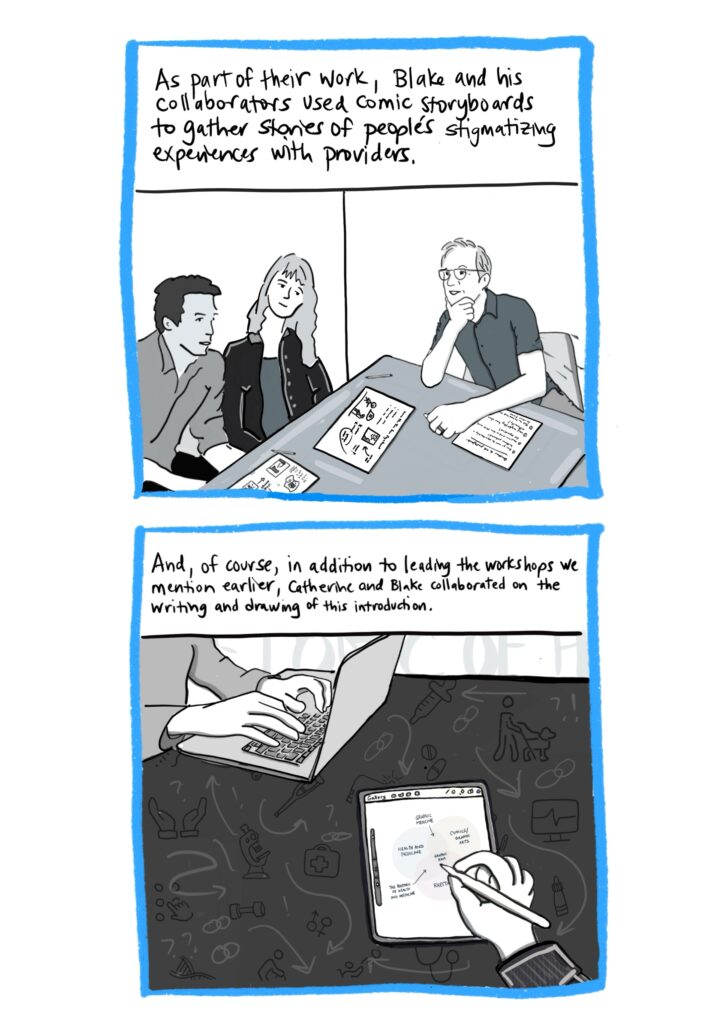
Panel 15 Image: Blake sitting at table with two research participants, one white woman and one Latino man, having a conversation with them about their drawings on comic storyboards used for data collection. Text: As part of their work, Blake and his collaborators used comic storyboards to gather stories of people’s stigmatizing experiences with providers. Panel 16 Image: Close up of Blake’s and Catherine’s hands on a table, with Blake typing on a laptop and Catherine drawing a Venn diagram on an iPad. The table background includes various medical images like those in a previous panel in different shades of black and grey. Text: And, of course, in addition to leading workshops together, Blake and Catherine collaborated on the writing and drawing of this introduction.
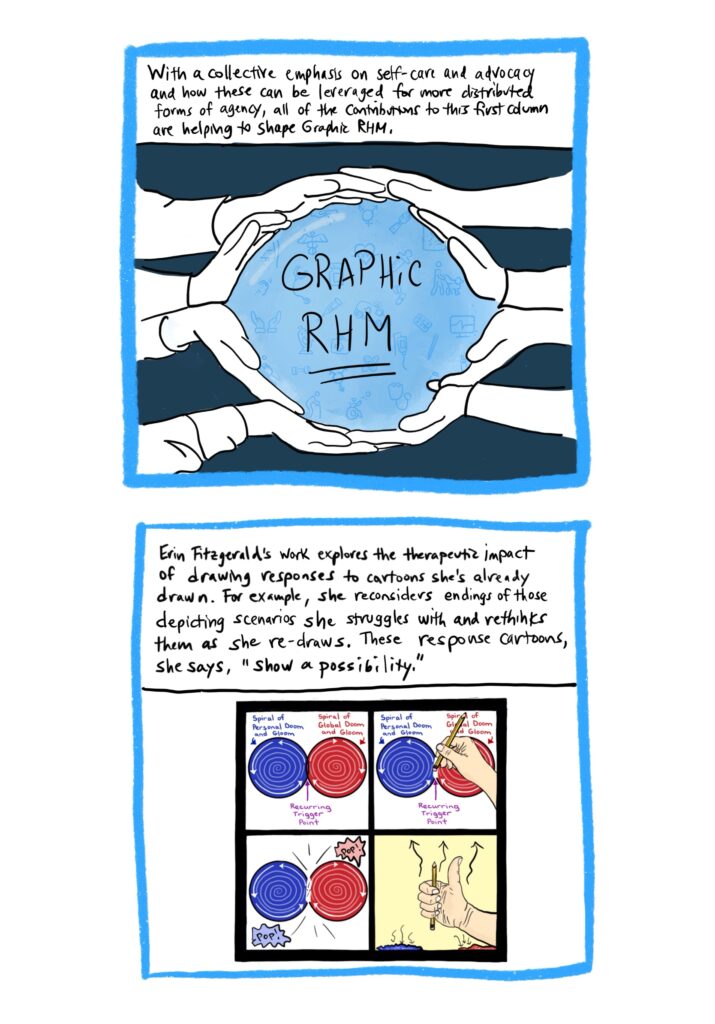
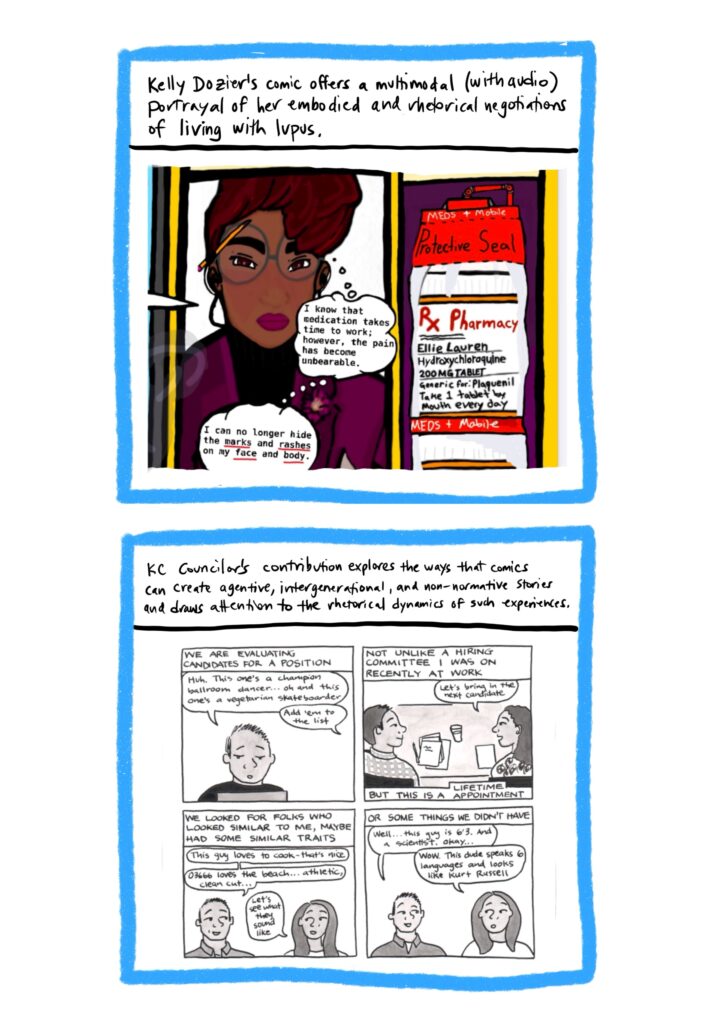
Panel 17 Image: Blue sphere, with words “Graphic RHM” and varied medical images—again like those from the previous panels—in the background. Various hands are surrounding the sphere and holding it. Text: With a collective emphasis on self-care and advocacy and how these can be leveraged for more distributed forms of agency, all of the contributions to this first column are helping to shape Graphic RHM. Panel 18 Image: Panel from Erin Fitzgerald’s comic, which shows her drawing her way out of a “recurring trigger point” by popping two spirals, a blue one of “personal doom and gloom” and a red one of “global doom and gloom.” Text: Erin Fitzgerald’s work explores the therapeutic impact of drawing responses to cartoons she’s already drawn. For example, she reconsiders endings of those depicting scenarios she struggles with and rethinks them as she re-draws. These “response cartoons,” she says, “show a possibility.”
Panel 19 Image: Section from Kelly Dozier’s comic, which shows patient living with lupus thinking about how long her medication is taking to work and how she can’t hide the marks and rashes caused by the disease. Section also shows a medication bottle for Plaquenil. Text: Kelly Dozier’s comic offers a multimodal (an audio file with music accompanies the comic) portrayal of her embodied and rhetorical negotiations of living with lupus. Panel 20 Image: Section from KC Councilor’s comic, which shows conversations with his partner about evaluating sperm donor candidates. Text: KC Councilor’s contribution explores the ways that comics can create agentive, intergenerational, and non-normative stories and draws attention to the rhetorical dynamics of such experiences.
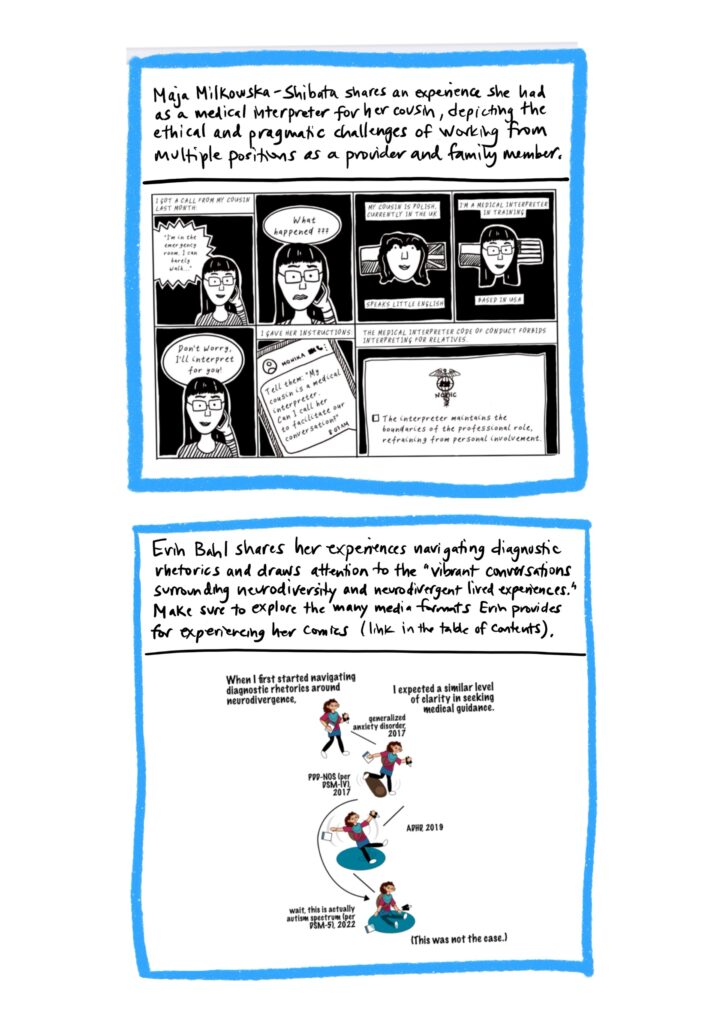
Panel 21 Image: Panel from Maja Milkowska-Shibata’s comic, which shows some of her ethico-professional challenges in medically interpreting for her cousin. Text: Maja Milkowska-Shibata’s comic shares her experience as a medical interpreter for her cousin, depicting the ethical and pragmatic challenges of working from her multiple positions as a provider and family member. Panel 22 Image: Panel from Erin Bahl’s comic, which shows her physically tripping and falling as a metaphor for challenges she has faced navigating diagnostic rhetorics. Text: Erin Bahl shares her experiences navigating diagnostic rhetorics and draws attention to the “vibrant conversations surrounding neurodiversity and neurodivergent lived experiences.”
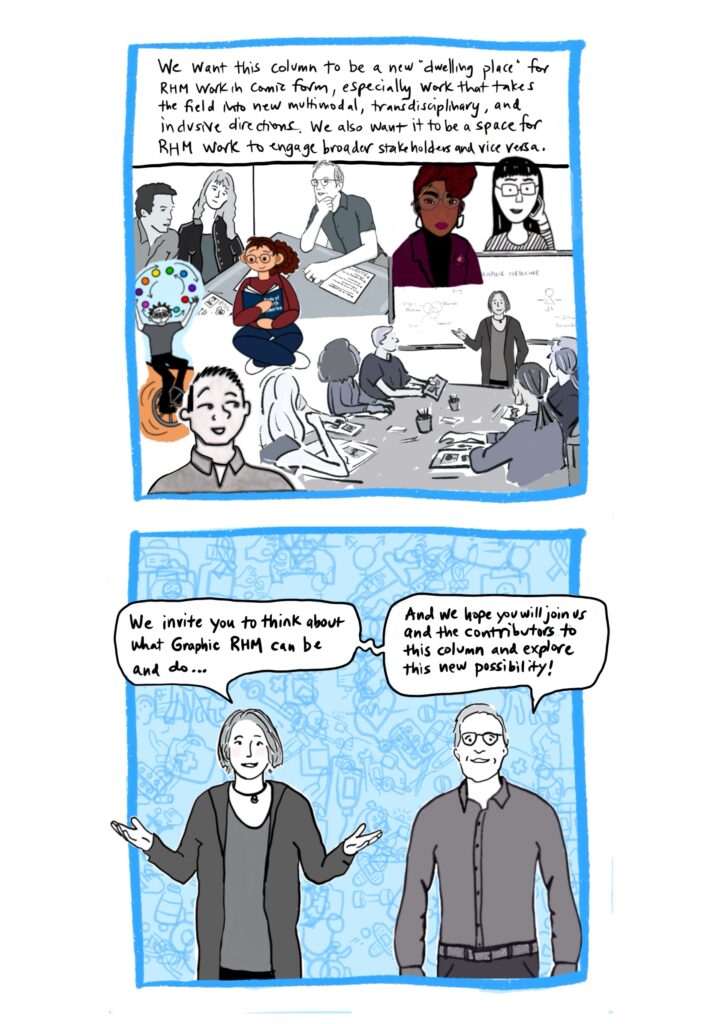
Panel 23 Image: There are floating excerpts from earlier panels depicting each of the contributors as they drew themselves (some in full color and some in greyscale), Blake talking with people experiencing HIV stigma, and Catherine teaching. Text: We want this column to be a new “dwelling place” for RHM work in comic form, especially work that takes the field into new multimodal, transdisciplinary, and inclusive directions. We also want it to be a space for RHM work to engage broader stakeholders and vice versa. Panel 24 Image: Catherine and Blake standing and facing reader, with Catherine’s arms out in an explanatory pose. Both are speaking and with various medical images in the background; this time there are many more than in previous panels and they are all overlapping, with some intentionally hard to see. Text: We invite you to think about what Graphic RHM can be and do, and we hope you will join us and the contributors to this first column and explore this new possibility!

Author Bios

Catherine Gouge (she/her) is Professor of English at West Virginia University, where she founded a medical humanities program and teaches courses in writing and rhetoric. She is co-editor, with Blake Scott and KC Councilor, of the forthcoming book Graphic Conversations: RHM Comics for Teaching, Research, and Engagement. In addition to drawing for both the Graphic Conversations collection and this Graphic RHM column, she has contributed comics to multiple edited volumes. In these comics and others, she uses drawing as a way to document, process, question, and reflect.

The former founding co-editor of RHM, Blake Scott (he/him) is Professor of Writing & Rhetoric at the University of Central Florida, where he teaches a wide range of courses in medical, civic, and professional writing and rhetoric. He’s working with Catherine Gouge and KC Councilor on an edited collection of comics titled “Graphic Conversations” and a set of HIV provider training comics to combat stigma.

To Cite

Gouge, Catherine and J. Blake Scott. (2024). Introduction to Graphic Medicine Column One. Rhetoric of Health & Medicine, 6(4), http://medicalrhetoric.com/graphicRHM/home/archive/column-1/column-1-introduction/