
Access this comic as a PDF or read below.
Comic Takeaways
- Rhetorically focused autobiographical comics can provide a lens that re-humanizes seemingly sterile clinical healthcare experiences, such as those around fertility care.
- Humor, and the lightheartedness it can manifest, can be a useful form of self-care for queering fraught healthcare experiences and normalizing meanings associated with them.
- Comics also have the potential to create agentive, intergenerational, and non-normative stories around family formation, identity, and values.
- Comic creation can offer a way to inventively process and share challenging healthcare decisions that have shaped our and others’ existence, and it can also bring attention to the rhetorical dynamics of communicating such experiences.
Artist Statement
I am equal parts cartoonist and rhetorical scholar—any comic I draw is informed by my training as a rhetorician, and any scholarship I write comes through my visual storytelling lens as a cartoonist. My comics are nonfiction and occasionally academic, but more often they are about the experience of being a transgender and transitioning person in the world. My most recent transition has been becoming a parent—a dad to our baby Robin, who turns one year old the week I’m drafting this statement. Throughout our IVF journey, my partner’s pregnancy, Robin’s birth, and sporadically during the tumult of this first year, I’ve drawn comics documenting the experience. My most important audience is Robin. I want her to have a strong sense of who she is, where she comes from, to whom she belongs and who belongs to her. I also hope to eventually publish a book of these comics that speaks particularly to queer parents, to dads, and to the many people who don’t feel seen or heard in the slew of mommy blogs, podcasts, and parent lit. How do we make meaning around families, especially when they fall outside the norm? How can we humanize the often-sterile world of fertility care? What effect might sharing stories of queer parenting have in the public sphere writ large?
Going to the doctor had always been a fraught experience for me—a mix of anxiety, shame, and fear; it was also a source of comic creation that I overlooked. MK Czerwiec, aka “Comic Nurse,” is the first person who taught me that you can make comics about healthcare experiences. Discovering MK’s work opened up a world of empowerment and curiosity around these experiences, and I started to make comics about the medical aspects of gender transition. I went into doctors’ offices with more confidence, knowing that if I had a bad or awkward encounter, I’d have great material for a comic. Throughout the process of fertility treatment, pregnancy, and birth, those same tools for storytelling and meaningmaking through comics helped me process complex experiences and share them with others.
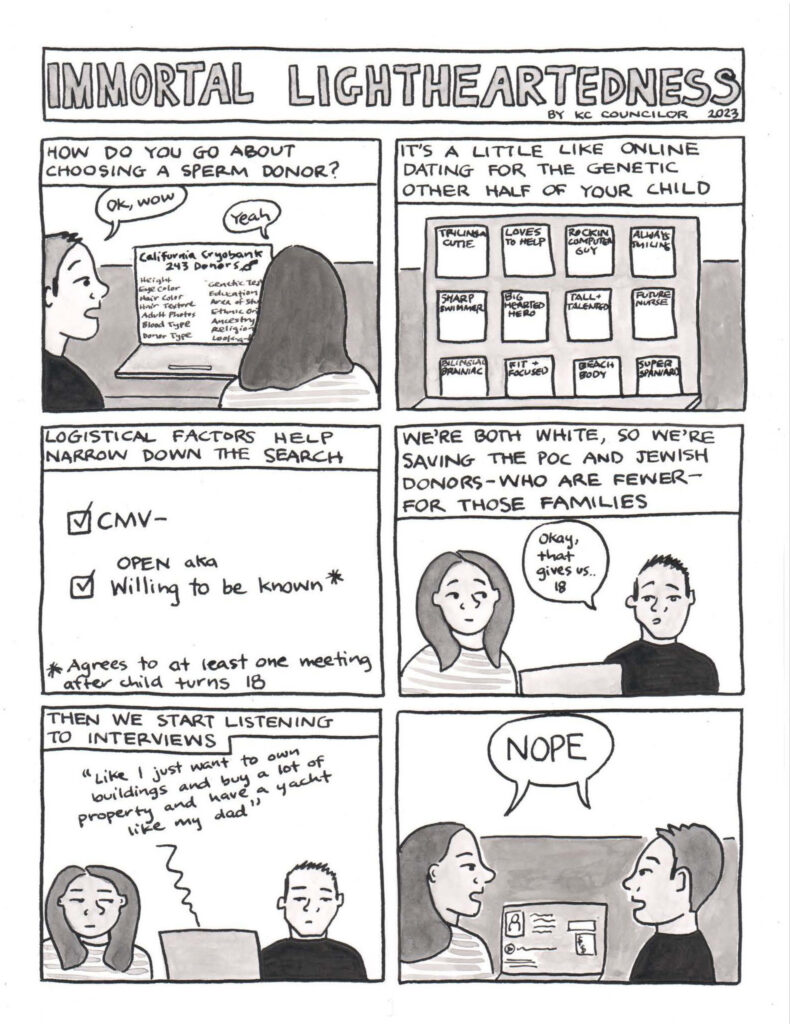
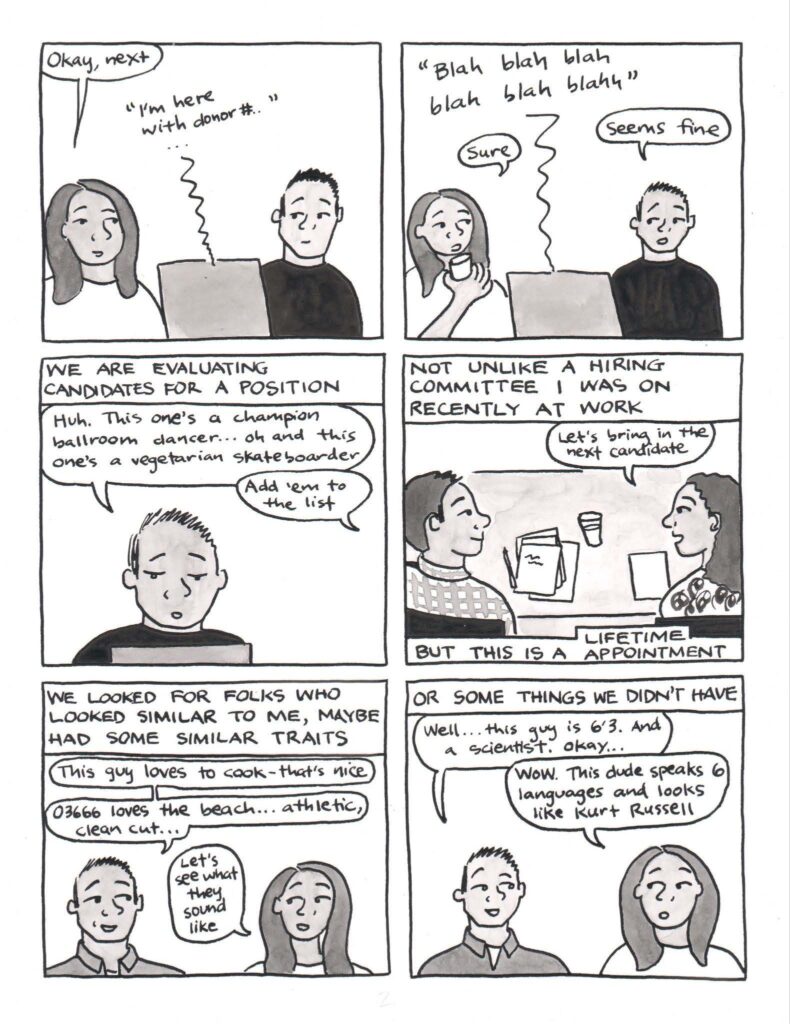
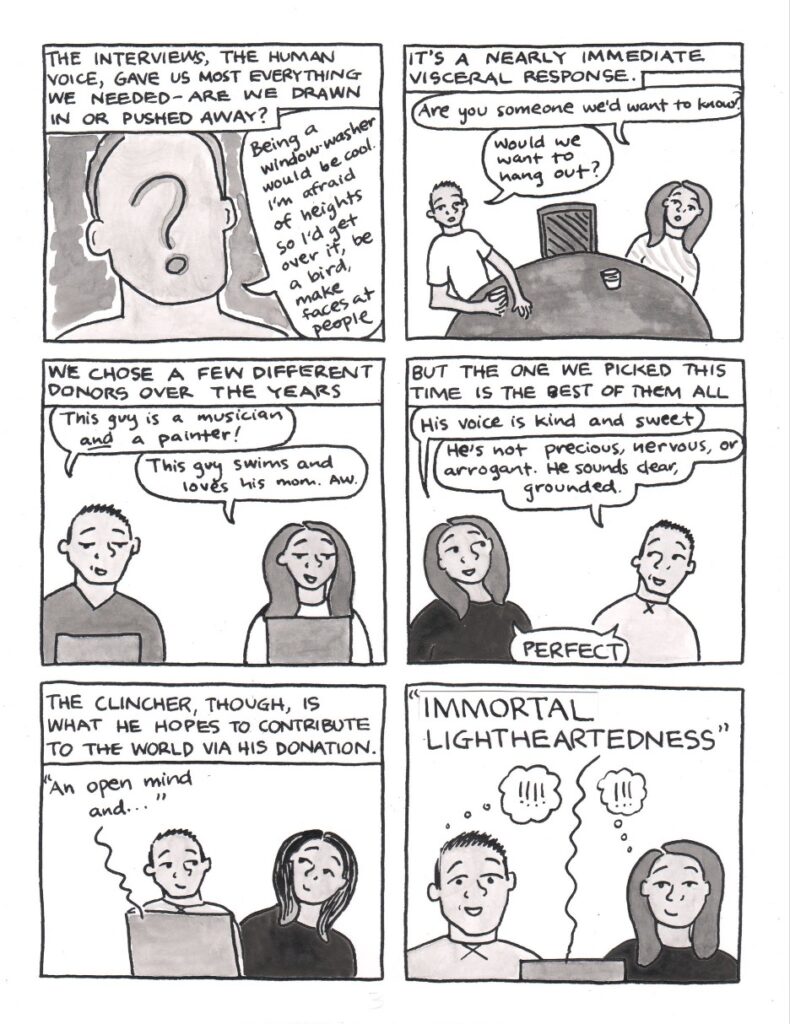
Choosing a sperm donor—the genetic other half of your (hopeful) future child(ren)—is an impossible task, almost laughably so. At reputable sperm banks, all donors have been thoroughly screened. Everyone looks good on paper. Having a baby is perhaps one of the most fundamental human experiences, and yet my partner and I were choosing sperm identified by a five-digit number, the process being a strange combination of online dating, online shopping, and electronic medical records. I don’t know how other people go about making this decision, but we needed a story for ourselves to help us make sense of this impossible choice, and I wanted to share that story with our future child as a comic, as well as other people who will be in that spot.
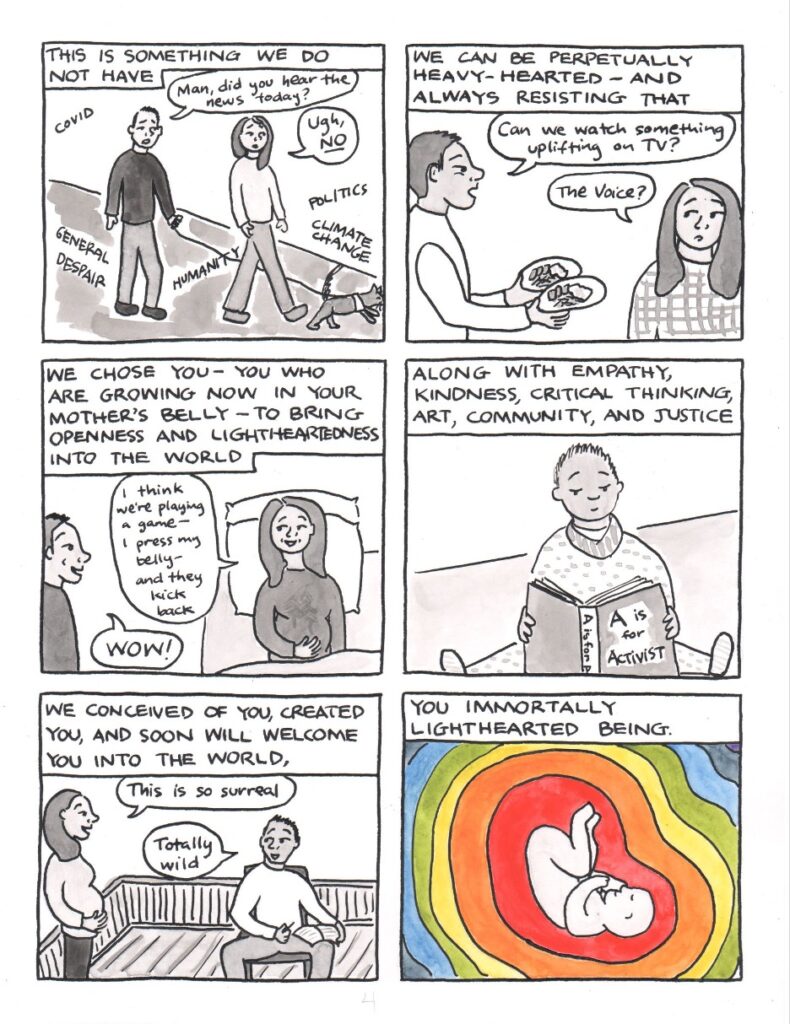
There is a lot of stigma and shame related to infertility, including not being woman enough to be a mother or virile enough of a man to get a woman pregnant. I know people whose parents never told them they were the product of donor sperm, that their biological father was not the one who raised them. Since we first conceived of having a family through our word, I knew that I did not want my trans identity to be some weird secret to our kids, something they “find out” or that we have an awkward talk about when they are teenagers. Being trans is part of the story of who I am, and it’s part of the story of who they are, too—I want them to claim this as a point of pride, or at least give them a powerful framing of their origin story. All of this is rhetorical negotiation at its core—making meaning through language for very complex experiences without singular fixed meanings.
I painted “Immortal Lightheartedness” on Bristol paper with Sumi ink and inexpensive brushes, and I shaded it with gray washes using the ink. I often sketch out a rougher version in a notebook or write down key phrases or images before I commit to the final paper. I learned to make comics from my teacher Lynda Barry, which means I work by hand with ink on paper and don’t do anything digital besides scan the pages. Among her books and YouTube videos, Lynda’s Making Comics is especially helpful, as is Ivan Brunetti’s Cartooning: Theory and Practice; both of these books can take you through a self-guided comics-making experience.
References
Brunetti, Ivan. (2011). Cartooning: Theory and practice. Yale University Press.
Barry, Lynda. (2019). Making comics. Drawn and Quarterly.
Click on an image below to open a larger version.
Artist Bio
KC Councilor (he/him) is a cartoonist and communication professor at Southern Connecticut State University in New Haven, CT. He earned his PhD in Communication Arts/Rhetoric at the University of Wisconsin-Madison, where he also learned how to make comics with Lynda Barry. His first book, Between You and Me: Transitional Comics, came out in 2019. He has published comics in Mutha Magazine, the Rumpus, Women’s Studies in Communication, Social Science & Medicine, QED, Annals of Internal Medicine, Literature & Medicine, and Communication and Critical/Cultural Studies. He is currently working on a new book of comics about parenting, masculinity, and queer worldmaking.
To Cite
Councilor, KC. (2023). Immortal lightheartedness [comics and artist statement]. Rhetoric of Health & Medicine, 6(4), http://medicalrhetoric.com/graphicRHM/home/archive/column-1/councilor/