
Access this comic as a PDF, read below, or visit the “Accordion Menu” presentation (Bahl’s website).
Comic Takeaways
- Conditions (such as autism spectrum and ADHD) have significantly increased in recent years (especially for latediagnosed adult women), and given that formal diagnostic processes for such conditions can be complicated to navigate, social media platforms can serve as helpful spaces for individuals to connect, share their stories, and offer mutual support in navigating neurodiverse lived experiences.
- Comics about navigating neurodiverse lived experiences can be empowering and widely shareable vernacular responses to limiting institutionalized medical rhetorics.
- Carefully considering comic media, tools, and formats (in this case digital comics featuring layered vector art and modular square panels) is an important part of making accessibility an integral part of the design process.
- As scholars and artists, rhetoricians of health and medicine can make meaningful contributions to neurodivergent expression and social media advocacy via comics and visual art.
Artist Statement
Exigence
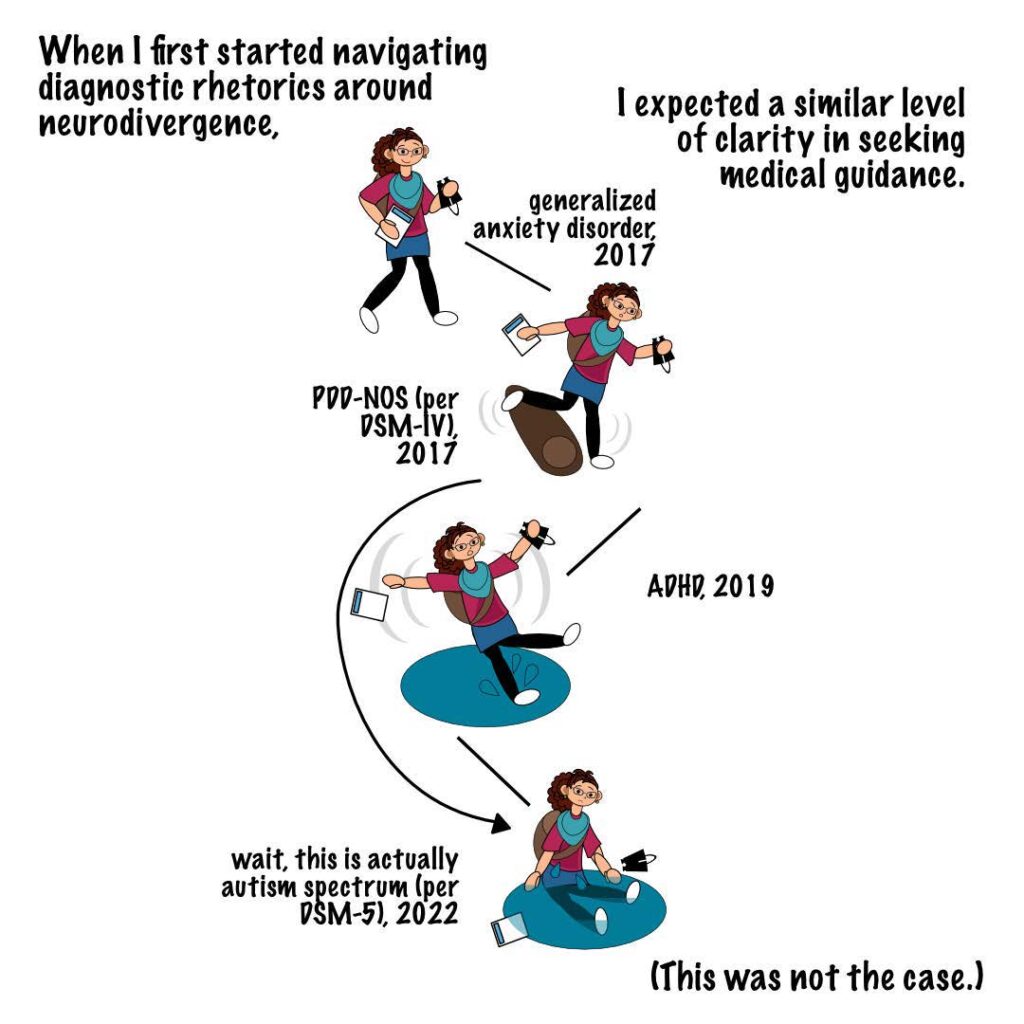
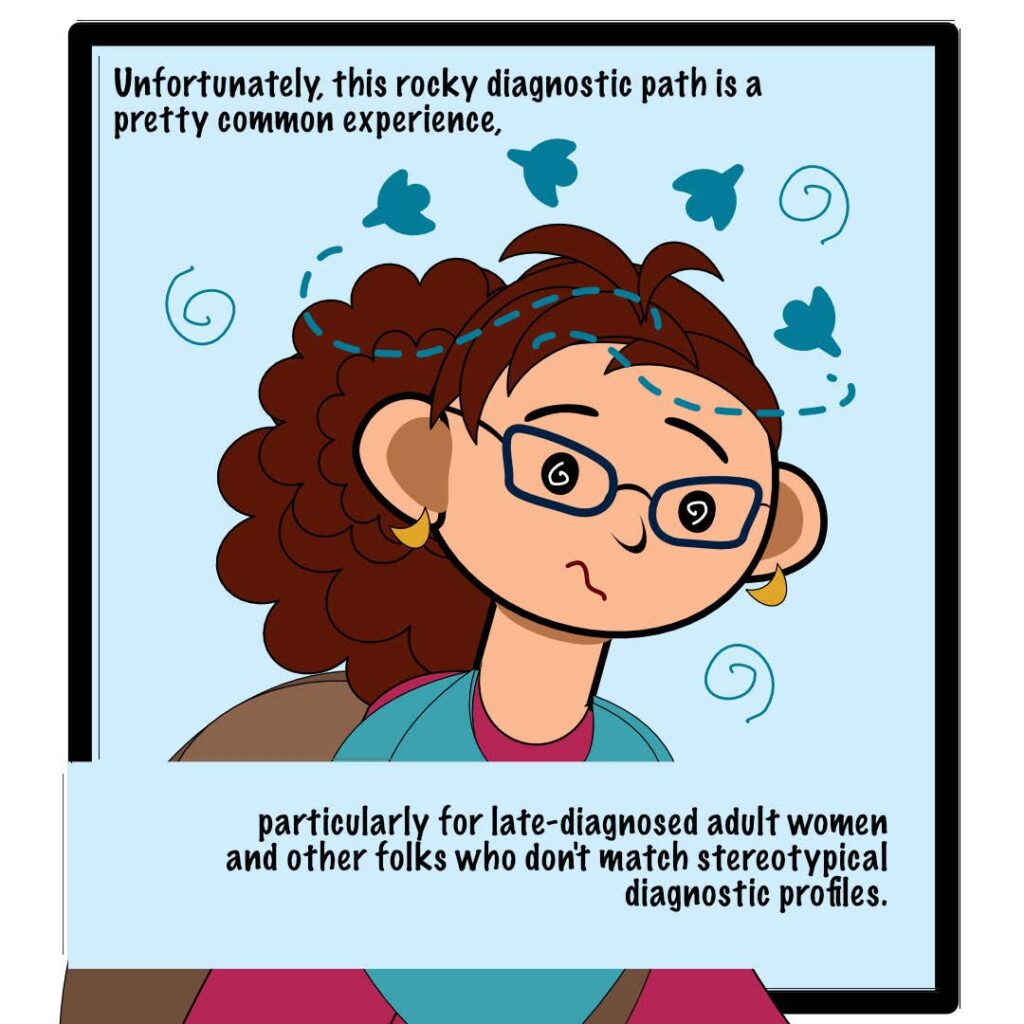
This short comic is intended to draw attention to the vibrant conversations around neurodiversity and neurodivergent lived experiences taking place on social media, as well as to share one account of a (fairly common) experience attempting to navigate diagnostic rhetorics as a late-diagnosed adult woman. “Neurodiversity” is a framework that views differences in cognition and brain function as part of a broader spectrum of human diversity, and includes conditions such as autism, ADHD, and dyslexia, among many others (for further discussion, access Garcia, 2022; Price, 2022; Silberman, 2016; Yergeau, 2018). Neurodiverse refers generally to natural diversity in human cognition; neurodivergent refers specifically to individuals whose brains processes information differently from normative patterns. (For further distinction on differences between these terms, refer to Rakshit, 2023; Neurodadversity, 2022; Wise, 2023a; and Wise, 2023b).
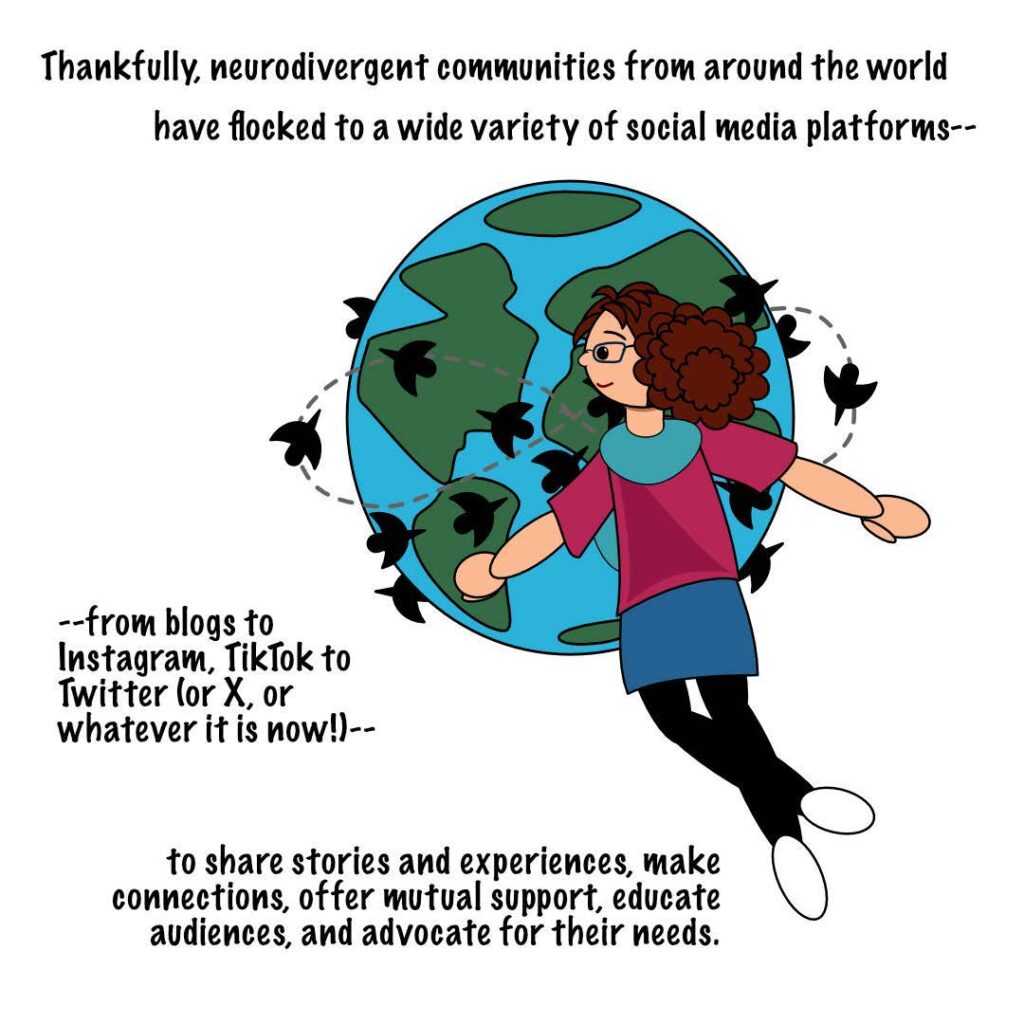
The rising rates of autism and ADHD diagnosis, especially for women, have been widely reported (consider, for example, Ciccone, 2023; Ghorayashi, 2023; Harmens et al., 2022; Hopkins, 2022; Rudy, 2023; Russell et al., 2023). Some factors include increased awareness of how these conditions present in populations other than that around which diagnostic criteria were initially developed (straight white upper/middleclass boys), as well as changes in diagnostic categories (such as the DSM-5’s [2013] shift to include conditions formerly diagnosed as autism, Asperger’s, and PDD-NOS under the single umbrella of “autism spectrum disorder”) (Garcia, 2022, pp. 3-5). Social media platforms have served as tools for many neurodivergent individuals to seek community, connection, and support in making sense of their experiences, particularly in light of gaps in formalized medical support. These platforms serve as informal spaces to come together to navigate and challenge institutionalized medical rhetorics through creative vernacular responses grounded in lived experiences (Blank & Kitta, 2015).
Scholarship
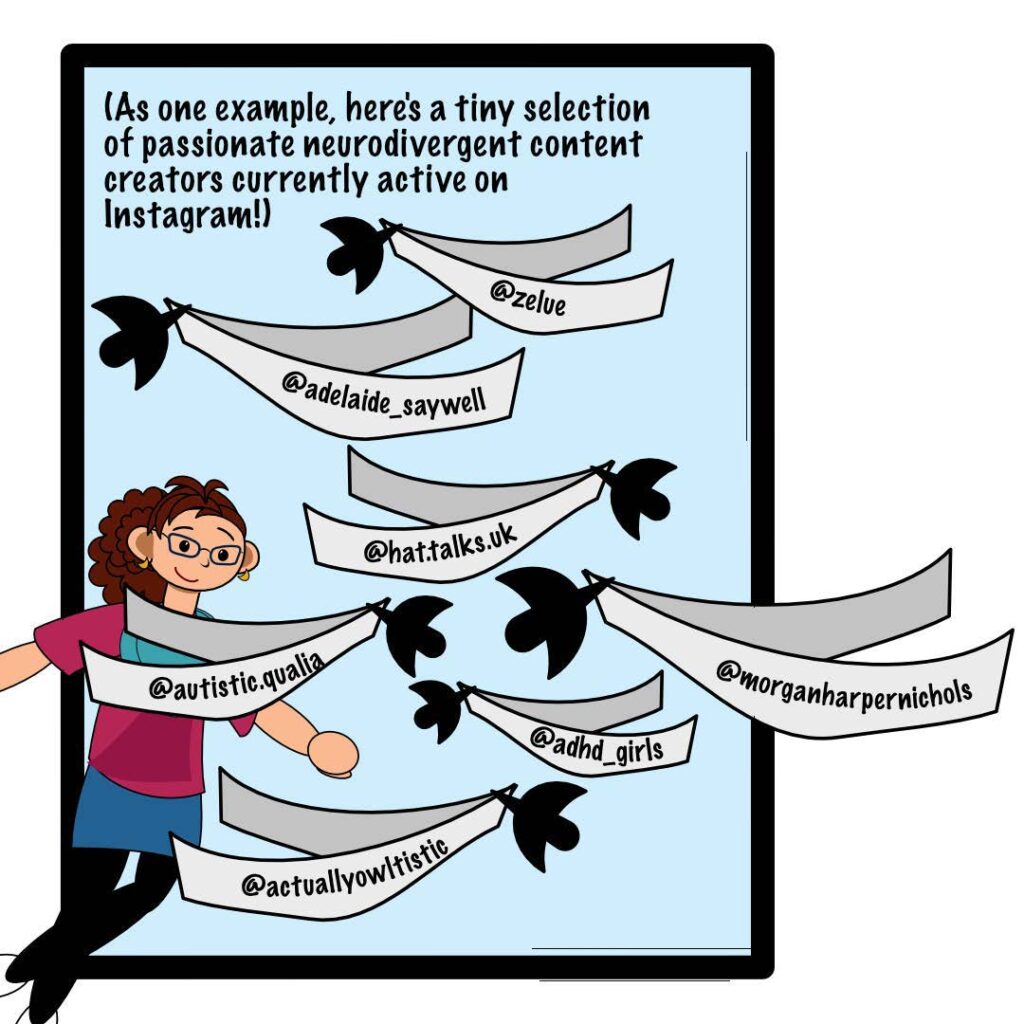
Within digital rhetorical and disability scholarship, this comic is deeply informed by the work of M. Remi Yergeau (Heilker & Yergeau, 2011; Yergeau, 2011; Yergeau et al., 2013; Yergeau, 2018), work on autistic social media advocacy by Ruth Osorio (2020), Devon Price’s Unmasking Autism (2022), and many, many memoirs and self-accounts by neurodivergent individuals from a range of backgrounds (Kim, 2014; Prahlad, 2017; Warman, 2022; May, 2023, Lim, 2023). Specifically regarding neurodivergent expression via comics and visual art, this piece is in conversation with the Sensory anthology (Ollerton, 2022) and Drawing Autism (Mullin, 2014), as well as webcomics on autistic and ADHD experiences (such as those by @actuallyowltistic, n.d., and @ADHDcouple, n.d.). Concerning using short comics to share lived experiences and advocate for marginalized groups’ health and well-being, this piece especially builds on the work of The Most Costly Journey (Bennett et al., 2021), Technical Communication Quarterly’s special issue on “Comics and Graphic Storytelling in Technical Communication” (Bahl et al., 2020); ImageText’s special issue on “Technical Storytelling: Comics and Community” (Slotkin & Gonzales, 2023), and the arts-based research of Sally Pirie. Stylistically as a life narrative work presented through brightly colored cartoon figures, this piece is especially intended as an homage to Raina Telgemeier’s brilliant cartooning and emotional visual storytelling.
Process
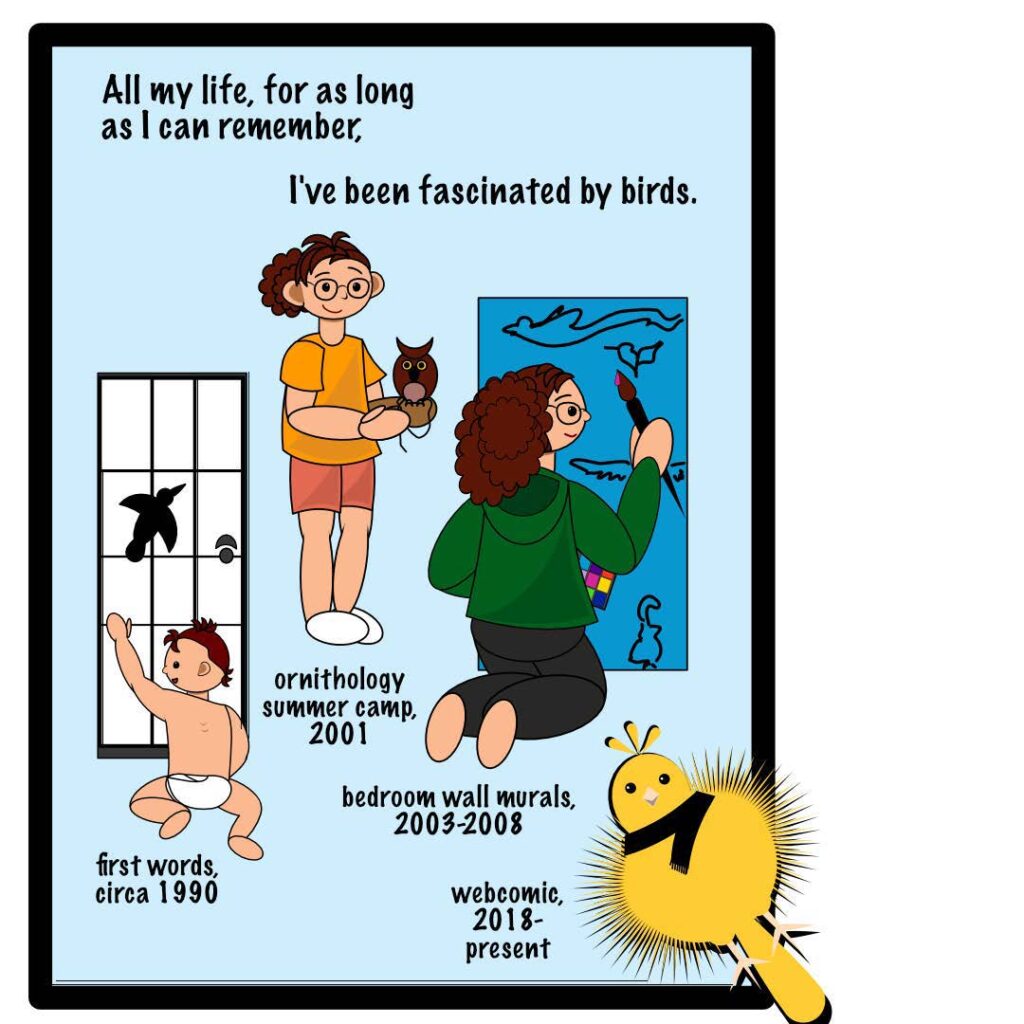
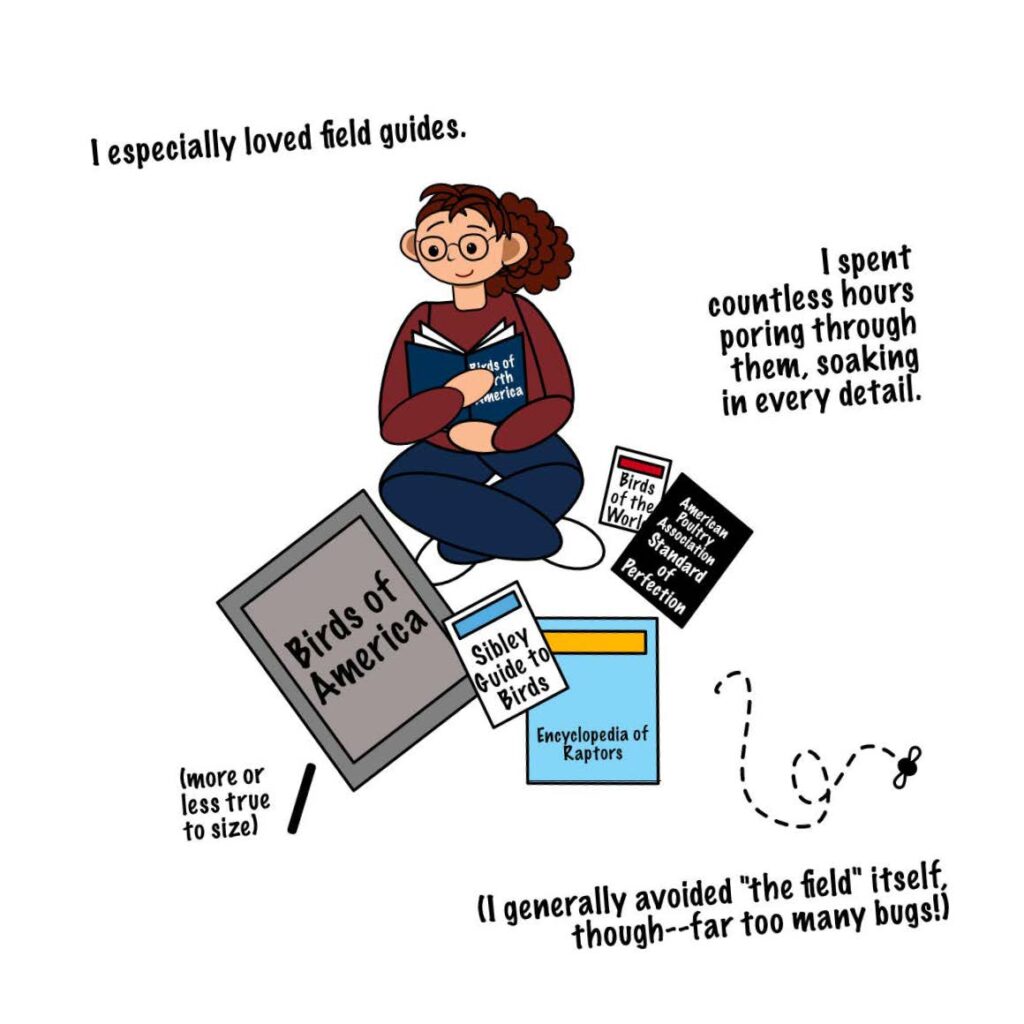
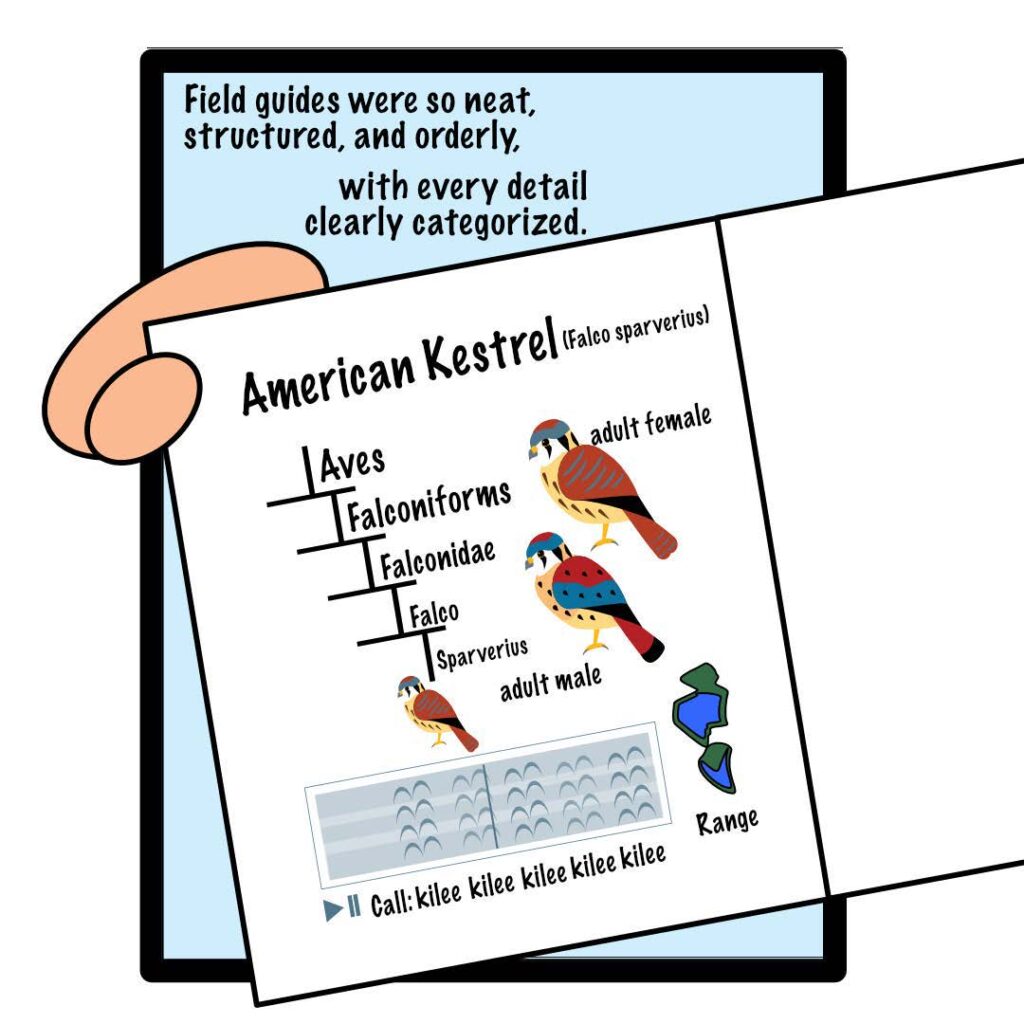
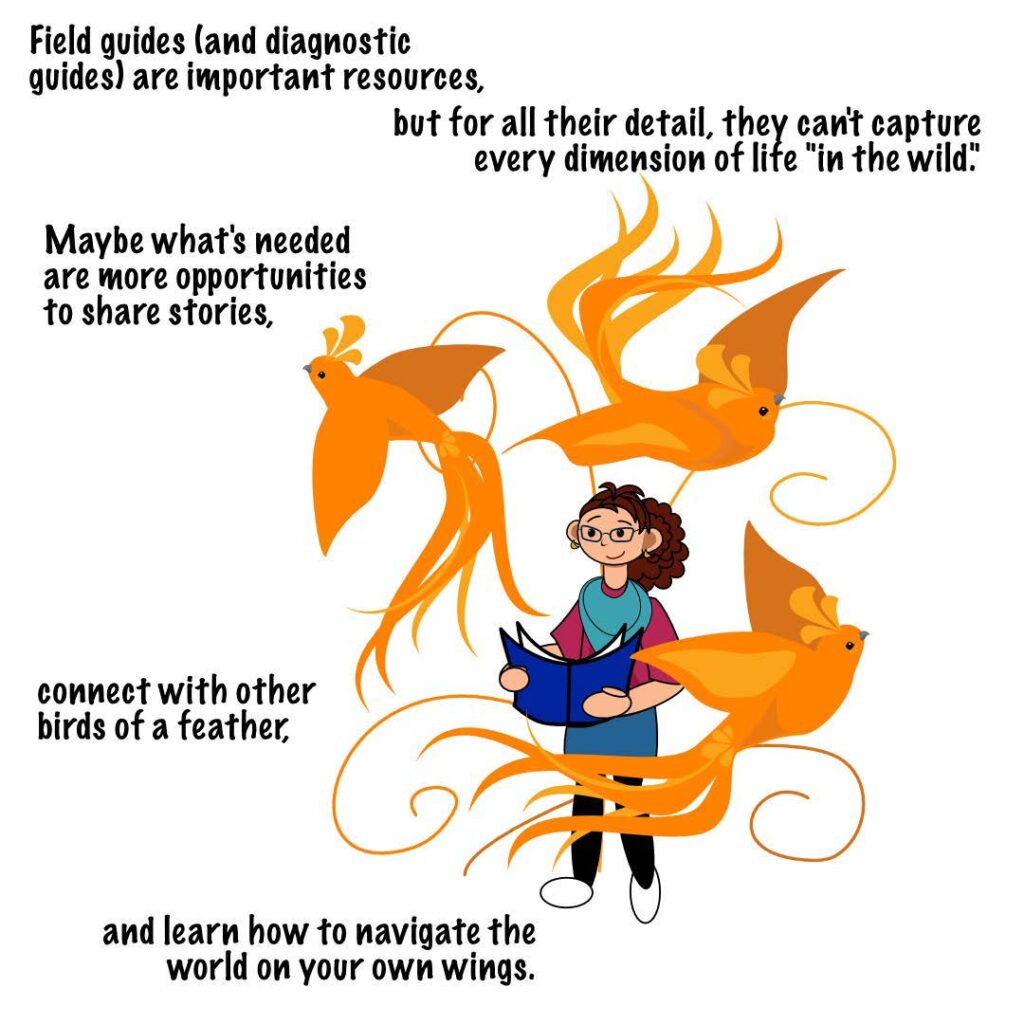
This comic was created in Affinity Designer using layered vector art shapes (with solid black outlines—a distinct stylistic departure from my typical bird illustration style in creating anthropomorphic fantasy bird webcomics, intended to reflect a different approach to reflective personal narrative grounded in human embodied experience). The web shell was created in HTML using Atom.io and adapted from a collaborative webtext coauthored and codesigned with Margaret Price, published in Kairos: A Journal of Rhetoric, Technology, and Pedagogy, and recipient of the Kairos Best Webtext Award in 2023. Bird illustrations were borrowed from other author-created comics, including Little Yellow Bird (n.d.), “Ashen Cadence” (2023), and another in-progress project. The piece was developed as a set of modular square panels that could be adapted for a number of online formats, including vertical scroll, swipe through, and more traditional page layouts. Reflecting the narrator’s evolving understanding of complicated medical diagnostic processes, the comic moves from sharp, hierarchical lines in the field guide image, to zigzags in various (mis)directions, to softer, rounder shapes and swirls in emphasizing communities connecting through lived experiences. As a short, digitally generated comic, the format also lends itself to experimentation with multiple access options, including author-read audio plus transcript and short video with images plus audio description. This modularity and accessible design is an attempt to build on the work of the Accessible Comics Collective (2023), as well as to work toward making accessibility an integral part of the design of creative multimodal communication (Bahl & Price 2022; Zdenek, 2018; Butler, 2018).
I would like to especially thank the anonymous peer reviewer for their kind, clear, and through explanation in highlighting key definitional distinctions between neurodiversity and neurodivergence.
References and Additional Informing Sources
Accessible Comics Collective, Longmore Institute. (2023). Innovations in accessible comics for blind & low vision readers. YouTube. https://www.youtube.com/watch?v=7sd9Le3jmmM&ab_channel=LongmoreInstitute
Actually Owltistic (@actuallyowltistic). (n.d.) Instagram. https://www.instagram.com/actuallyowltistic/
Ingri (@adhd_couple). (n.d.) Instagram. https://www.instagram.com/adhd_couple/
Asta, Catherine. (n.d.). The late discovered club podcast. https://www.podpage.com/the-late-discovered-club/
Bahl, Erin Kathleen. (n.d.). Little yellow bird. Instagram. https://www.instagram.com/lybcomic/
Bahl, Erin Kathleen. (2023). Ashen cadence. In Storytelling Collective, Collective panels, volume 2 (n.p.). DriveThruComics. https://www.drivethrucomics.com/product/436566/Collective-Panels–Volume-II
Bahl, Erin Kathleen, Figueiredo, Sergio, & Shivener, Rich (Eds.). (2020). Special issue on comics and graphic storytelling in technical communication. Technical Communication Quarterly, 29(3), 219-221. https://www.tandfonline.com/toc/htcq20/29/3
Blank, Trevor J., & Kitta, Andrea. (2015). Diagnosing folklore: Perspectives on disability, health, and trauma. University Press of Mississippi.
Bennett, Marek, Kolovos, Andy, and Mares, Teresa. (Eds.). (2021). The most costly journey/El viaje mas caro: Stories of migrant farmworkers in Vermont drawn by New England cartoonists. Vermont Folklife Center.
Butler, Janine. (2018). Embodied captions in multimodal pedagogies. Composition Forum, 39. https://compositionforum.com/issue/39/captions.php
Ciccone, Carla. (2022, 5 September). Coming into focus. Harper’s Bazaar. https://www.harpersbazaar.com/culture/features/a41083545/adhdin-adult-women/
Dhakar, Lokesh. (n.d.). Lightbox2. https://lokeshdhakar.com/projects/lightbox2/
Garcia, Eric. (2022). We’re not broken: Changing the autism conversation. Harvest Press.
Ghorayashi, Azeen. (2023, April 10). More girls are being diagnosed with autism. The New York Times. https://www.nytimes.com/2023/04/10/science/autism-rategirls.html
Harmens, Miriam, Sedgewick, Felicity, & Hobson, Hannah. (2022). Autistic women’s diagnostic experiences: Interactions with identity and impacts on well-being. Women’s Health, 18. https://journals.sagepub.com/doi/10.1177/17455057221137477
Heilker, Paul & Yergeau, M. Remi. (2011). Autism and rhetoric. College English, 73(5), 485-497. https://www.jstor.org/stable/23052337
Hendrickx, Sarah. (2015). Women and girls with autism spectrum disorder: Understanding life experiences from early childhood to old age. Jessica Kingsley Publishers.
Hopkins, Caroline. (2022, Dec. 17). ADHD in women: Symptoms develop in childhood, but the signs are often missed. NBC News. https://www.nbcnews.com/health/health-news/adhd-women-symptomsoverlooked-rcna60240
How to ADHD (@HowtoADHD). (n.d.) YouTube. https://www.youtube.com/@HowtoADHD
Hubrig, Ada (@AdaHubrig). (n.d.). Twitter. https://twitter.com/AdaHubrig
Kim, Cynthia. (2014). Nerdy, shy, and socially inappropriate: A user guide to an Asperger life. Jessica Kingsley Publishers.
Lim, Hazel. (2023, April 6). Interview with Catherine Asta. The late discovered club podcast. https://www.podpage.com/the-late-discovered-club/episode-15-breaking-barriers/
May, Katherine. (2023, June 20). 220. Why so many women don’t know they are autistic. Interview. We can do hard things with Glennon Doyle. https://momastery.com/blog/we-can-do-hard-things-ep-220/
Mom on the Spectrum (@MomontheSpectrum). (n.d.) YouTube. https://www.youtube.com/@MomontheSpectrum
Mullin, Jill. (2014). Drawing autism. Akashic Books.
Neurodadversity. (2022, Aug. 15). What is neurodivergence? Am I neurodiverse? Are you neurodivergent? Neurodiversity explained. Neurodiversity Matters. https://neurodiversitymatters.com/what-is-neurodivergence-am-ineurodiverse-are-you-neurodivergent-neurodiversity-explained/
Ollerton, Bex (Ed.). (2022). Sensory: Life on the spectrum: An autistic comics anthology. Andrews McMeel Publishing.
Osorio, Ruth. (2020). I am #ActuallyAutistic, hear me tweet: The autisttopoi of autistic activists on Twitter. enculturation: A Journal of Writing, Rhetoric, and Culture. https://enculturation.net/I_Am_ActuallyAutistic
Pirie, Sally. (n.d.). Selected publications. https://sallypirie.com/publications/
Prahlad, Anand. (2017). The secret life of a Black Aspie: A memoir. University of Alaska Press.
Price, Devon. (2022). Unmasking autism: Discovering the new faces of neurodiversity. Harmony Press.
Price, Margaret, & Bahl, Erin Kathleen. (2022). The rhetoric of description: Embodiment, power, and playfulness in representations of the visual. Kairos: A Journal of Rhetoric, Technology, and Pedagogy, 26(2). https://kairos.technorhetoric.net/26.2/topoi/price-bahl/index.html
Purple Ella (@PurpleElla). (n.d.). YouTube. https://www.youtube.com/@PurpleElla
Rakshit, Devrupa. (2023, Oct. 13). Why ‘neurodiversity’ and ‘neurodivergence’ shouldn’t be used interchangeably. The Swaddle. https://www.theswaddle.com/why-neurodiversity-andneurodivergence-shouldn-t-be-used-interchangeably
Rudy, Melissa. (2023, Apr. 5). ADHD numbers climbing dramatically in the U.S., especially among women: study. New York Post. https://nypost.com/2023/04/05/adhd-numbers-rise-in-the-u-sespecially-among-women-study/
Russell, Jim, Franklin, Blaine, Piff, Alex, Allen, Steve, & Barkley, Eric. (2023, Mar. 30). Number of ADHD patients rising, especially among women. Epic Research. https://epicresearch.org/articles/number-of-adhd-patients-risingespecially-among-women
Silberman, Steve. (2015). Neurotribes: The legacy of autism and the future of neurodiversity. Avery.
Slotkin, Alexander & Laura Gonzales, eds. (2023). Special issue on technical storytelling: Comics and community. ImageText, 14(1). https://imagetextjournal.com/category/volume-14-issue-1/
Telgemeier, Raina. (2019). Share your smile: Raina’s guide to telling your own story. Scholastic Graphix.
Warman, Brittany. (2022, April 12). OCD and sleeping princesses. The Carterhaugh School of Folklore and the Fantastic. https://carterhaughschool.com/ocd-andsleeping-princesses/
Wise, Sonny Jane (@livedexperienceeducator). (2023a, Jan. 5). Instagram post. https://www.instagram.com/p/CnDU-9fhdba/?utm_source=ig_web_copy_link&igshid=ODhhZWM5NmIwOQ%3D%3D
Wise, Sonny Jane (@livedexperienceeducator). (2023b, Jul. 6). Instagram post. https://www.instagram.com/p/CuYGwCnv4q8/?utm_source=ig_web_copy_link&igshid=ODhhZWM5NmIwOQ%3D%3D
Yergeau, M. Remi. (2018). Authoring autism: On rhetoric and neurological queerness. Duke University Press.
Yergeau, M. Remi. (2011). Disabling composition: Toward a 21st-century, synaesthetic theory of writing. Dissertation. The Ohio State University. http://rave.ohiolink.edu/etdc/view?acc_num=osu1306418814
Yergeau, M. Remi, Brewer, Elizabeth Kerschbaum, Stephanie, Oswal, Sushil K., Price, Margaret Price, Selfe, Cynthia L., Salvo, Michael J., & Howes, Franny. (2013). Multimodality in motion: Disability & kairotic spaces. Kairos: A Journal of Rhetoric, Technology, and Pedagogy, 18(1). https://kairos.technorhetoric.net/18.1/coverweb/yergeau-etal/index.html
Yo Samdy Sam (@yosamdysam). (n.d.). YouTube. https://www.youtube.com/@YoSamdySam
Zdenek, Sean. (2018). Designing captions: Disruptive experiments with typography, color, icons, and effects. Kairos: A Journal of Rhetoric, Technology, and Pedagogy, 23(1).
http://kairos.technorhetoric.net/23.1/topoi/zdenek/index.html
Click on an image below to open a larger version.
Artist Bio
Erin Kathleen Bahl (she/her) is Associate Professor of Applied and Professional Writing at Kennesaw State University (Atlanta, GA), as well as the KSU English Department’s inaugural Social Media and Branding Coordinator. Her work focuses on creating knowledge, telling stories, and designing for access via digital scholarship, webcomics, folklore, and interactive narrative. Along with Chris Andrews, she serves as editor for Kairos: A Journal of Rhetoric, Technology, and Pedagogy as of August 2025. Her first book, a comics-form monograph, is forthcoming from Parlor Press’s “Comics and Graphic Narratives” series. Other publications include scholarly and creative work in Kairos; Computers and Composition Online; enculturation: A Journal of Writing, Rhetoric, and Culture; Technical Communication Quarterly; The Digital Review; Graphic RHM; The Digital Rhetoric Collabortive; Composition Studies; Humanities Journal; Journal of American Folklore; and The Smithsonian’s Folklife Magazine, as well as multiple edited collections.
To Cite
Bahl, Erin Kathleen. (2023). A field guide to neurodiversity [comic and artist statement]. Rhetoric of Health & Medicine, 6(4), http://medicalrhetoric.com/graphicRHM/home/archive/column-1/bahl/