
Access this comic as a PDF or read below.
Comic Takeaways
- An excerpt of a larger graphic narrative (“BENNU”), this comic reflects the author and illustrator K. Dozier’s lived experiences with lupus (SLE) and was developed out of her collaborative work with providers-in-training about how to learn more about the experiences of diverse patients.
- The visual modality of auto-ethnographic comics offers a uniquely agentive way to foreground the embodied aspects of navigating the challenging complexities of living with lupus.
- Auto-ethnographic comics can be a powerful medium for depicting and imagining a range of patient self-advocacy steps, such as 1) finding and engaging accessible healthcare providers and medications; 2) more broadly prioritizing their health through diet, rest, and stress-reduction, partly by leaning on supportive relationships and eliminating toxic ones; and 3) becoming aware of legislative protections for employees with disabilities or with health concerns for themselves or their family members.
- Comic depictions of patient self-care and self-advocacy can set the stage for more distributed forms of patient support and agency involving rhetoricians of health and medicine.
Artist Statement
As a Cum Laude student in Communication Studies and Liberal Arts from
Bakersfield College and a Summer Edge transfer student at the University of California Berkeley, I’ve endured the challenging complexities of systemic lupus erythematosus (SLE) and the disabilities associated with this autoimmune disease. The disease, for which there is no cure, causes the body’s immune system to attack healthy tissues; it affects my skin, joints, and significant vital organs such as the lungs, heart, and brain. I was diagnosed during the early phases of COVID-19, which led to some additional challenges. The FDA approved an emergency use authorization (EUA) on March 28, 2020 to allow the distribution of hydroxychloroquine to treat adults and some adolescents for COVID-19. Hydroxychloroquine is one of the main medications that lupus patients like me are prescribed to control the disease. Pharmacies limited our medication disruptions until the California State Board of Pharmacy, Department of Consumer Affairs, and the Medical Board of California issued a joint decision to remove any restrictions on prescribing or dispensing hydroxychloroquine for non-Medi-Cal patients. After results from a large randomized clinical trial demonstrated that hydroxychloroquine showed no benefit on mortality or in speeding recovery from COVID-19, the FDA revoked its EUA of the drug on June 15, 2020.
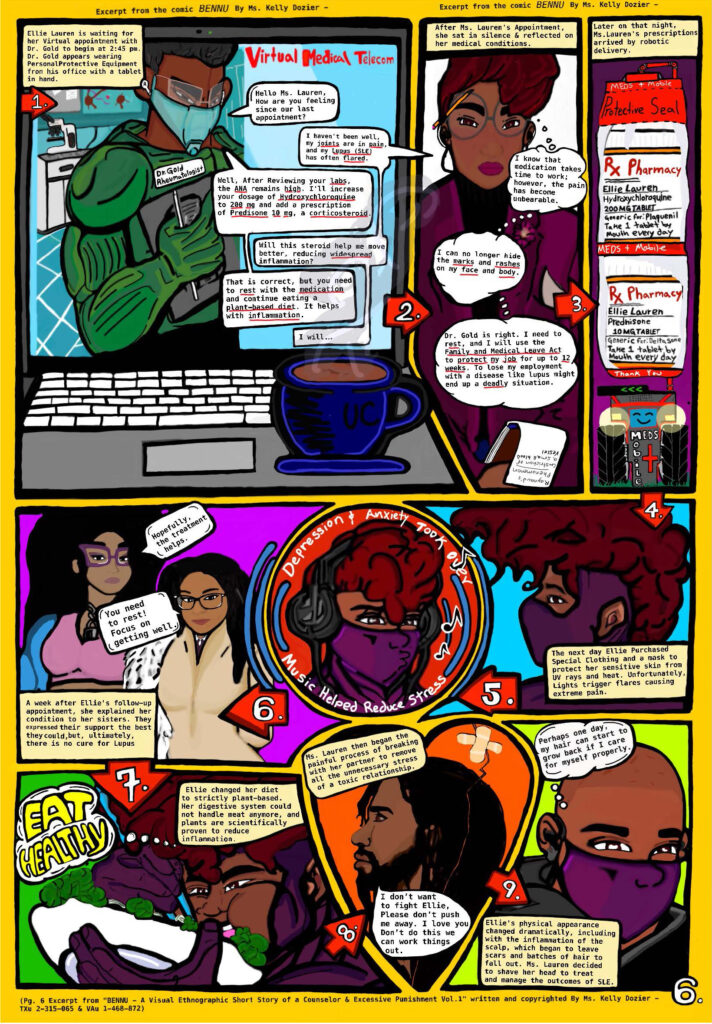
After enduring these circumstances, I decided to create the comic “BENNU—A Visual Ethnographic Short Story of a Counselor and Excessive Punishment, Volume 1.” This auto-ethnographic comic was inspired by my personal life and the challenges of a mixed-race, pansexual woman with SLE. The excerpt from page six of BENNU published in this column depicts the slow processes of adjusting to being diagnosed with SLE and the changes to everyday life in a futuristic world with virtual appointments, specialized personal protective equipment, and robotic medical deliveries. The narrators in the audio file accompanying the comic excerpt are me, Ms. Kelly Dozier, and Dr. Denise Dawkins from San Jose State University, voicing for Dr. Gold. I hope this comic will contribute to lupus education and awareness, inspiring others to advocate for themselves and legislation to protect lupus patients by prioritizing their healthcare.
Addendum by Blake Scott and Catherine Gouge
Dozier offers a multimodal portrayal of her embodied and rhetorical negotiations of living with SLE—not only as a patient but as a more fully dimensionalized person and agent. The comic’s relatively short sequence takes us through varied enactments of self-care, including securing medications and otherwise maintaining her physical health through resting, masking, eating healthy, and shaving her head. Her self-care also involves de-stressing through seeking support from her sisters, listening to music, and ending a toxic relationship.
Like other comics in this issue, we might see this one as portraying a version of what Siegel Finer, Molloy, and White-Farnham (2024) called a “patient epistemology,” which involves rhetorically engaging and reflecting on experiences with a “health flashpoint,” in this case entailing a flare-up of a chronic condition. Along with accounting for the patient’s multilayered lifeworld, Dozier’s comic adds, we think, a strong emphasis on embodied ways of knowing, meaning-making, and decision-making; thus, we might also call her comic an example of a “patient phenomenology,” one that illustrates her negotiations as embodied-rhetorical acts of agency. Dozier’s acts of self-care, from taking leave from work to bolstering hope for her future, are resourceful, drawing on her own strength and other forms of support as she adapts to changing circumstances and symptoms. In this way her negotiations, along with the act of creating comic itself, can be read as examples of metis, or cunning intelligence.
One element captured so beautifully by Dozier’s comic is the chaos that can emerge from engaging with the complexity of living with SLE. While Dozier’s multimodal graphic account may not fit neatly into the box of the classic “restitution narrative” (Frank, 1995, p. xiv), it gives us something much more valuable than a neat, Hollywood arc in which the person with illness arrives at a place where perfect health is restored and chaos is eliminated. It gives us an experience of embodied illness that recognizes the complexity of the sometimes-chaotic patient experience and the constellation of contexts and worlds the ill person must navigate. By telling her story this way, Dozier does what Frank (1995) argued is the value of narrative “instigated” by illness: It “give[s] voice to an experience that medicine cannot describe” (p. 18).
Dozier’s comic can be situated in the well-established graphic medicine tradition of autobiographies and memoirs created to foster selfunderstanding and advocacy around living with an illness or disease. Through its futuristic rendering of experiences that enables imaginative meditation and defies dominant depictions of patients as the passive recipients of healthcare, Dozier’s comic could also be viewed as a type of counterstory, one that blends elements of narrated dialogue, allegory, and autobiographical reflection discussed by Martinez (2020). As Dozier explains, “patients are the experts of their health and bodies” in this story. Through its multimodal form, this comic showcases the unique capacity of graphic medicine to convey sequential but also multilayered, intercontextual, and embodied acts of rhetorical agency.
In addition to portraying self-care as a form of activism, Dozier’s comic points to the potential of more distributed activism, as she indicates in calling for new legislation aimed at protecting lupus patients and as she suggests through the responses of those in the patient’s lifeworld. We can relate this double-move to Hensley Owens’ (2019) discussion of “rhetorical autoethnography,” in which “personal health-related writing allows a patient-writer to take control of her health narrative, to come to specific beliefs and understandings about her health, and to determine what actions are necessary” (p. 15). In addition to being forms of “microactivism,” Hensley Owens explained, such writing—or in this case comicmaking—can also be a “precursor of and inspiration for further activism” (p. 23).
Finally, as a form of auto-ethnography, Dozier’s comic can be viewed as a form of rhetorical research. In their “Dialogue on Possibilities for Embodied Methodologies in the Rhetoric of Health & Medicine,” Molloy et al. (2018) made the case that “Personal experiences can add a powerful dimension to research, and research that grows out of corporeal realities has the potential to help us to trust our bodies again after life-altering diagnoses. As well, recasting painful bodily experiences into our research agendas can offer productive ways to process the visceral and temporal dimensions of health and medical realities” (p. 366). By depicting a still too-often overlooked range of self-care enactments, Dozier’s comic offers us insights into our embodied methodologies and avenues for distributed agency as researchers, including how we can better account for and support the care of participants or subjects as whole people with “rhetorical ingenuity” (White-Farnham, Siegel Finer, & Molloy 2019).
Frank (1995) wrote that “the personal issue of telling stories about illness is to give voice to the body, so that the changed body can become once again familiar” (2). It is in this way, Frank argues, illness narratives are stories told not just about illness; rather, they are told through the body. “The body sets in motion the need for new stories when its disease disrupts old stories,” Frank argues, and in that way, the body is “simultaneously cause, topic, and instrument of whatever new stories are told” (2). Dozier’s comic about her embodied experience of SLE–like other auto-ethnographic illness narratives, presents us with opportunities to refigure our rhetorical expectations of what is possible. It helps us imagine and expand our ideas about what living with illness looks like, of what advocacy can look like, and of the value of distributed agency.
References
Frank, Arthur W. (1995). The wounded storyteller: Body, illness, and ethics. University of Chicago Press.
Owens, Kim Hensley. (2019). Writing my body, writing my health: A rhetorical autoethnography. In Jamie White-Farnham, Bryna Siegel Finer, & Cathryn Molloy (Eds.), Women’s health advocacy: Rhetorical ingenuity in the 21st century (pp. 14-24). Routledge.
Martinez, Aja Y. (2020). Counterstory: The rhetoric and writing of critical race theory. NCTE.
Siegel Finer, Bryna, Molloy, Cathryn, & White-Farnham, Jamie (Eds.). (2024). Patients making meaning: Theorizing sources of information and forms of support in women’s health. Routledge.
White-Farnham, Jamie, Siegel Finer, Bryna, & Molloy. Cathryn (Eds.). (2019). Women’s health advocacy: Rhetorical ingenuity in the 21st century (pp. 14-24). Routledge.
Click on an image below to open a larger version. Access a descriptive text file with audio transcript.
Artist Bio
Kelly Dozier (she/her) is a scholar-artist, behavior specialist, and disability advocate whose work blends sociology, visual storytelling, and inclusive program design. She is the author and illustrator of “BENNU: A Visual Ethnographic Short Story of a Counselor and Excessive Punishment, Volume 1”, a comic that explores varying disabilities—including lupus—while critiquing institutional control and engaging the intersections of medicine and legality as tools of resistance. A UC Berkeley graduate and Alpha Kappa Delta honoree, Kelly leads initiatives such as Sensory Days—autism spectrum–designed events supporting both hypo- and hypersensitivities.
To Cite
Dozier, Kelly. (2023). Excerpt from “BENNU”—a visual ethnographic short story of a counselor and excessive punishment, volume 1 [comic and artist statement]. Rhetoric of Health & Medicine, 6(4), http://medicalrhetoric.com/graphicRHM/home/archive/column-1/bennu/