
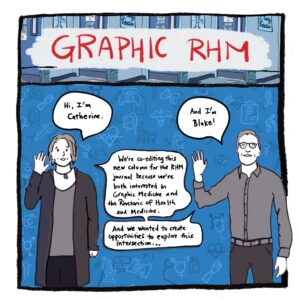
 In August 2022, we launched a call for submissions for a new digital, open access journal column dedicated to the intersection of the rhetoric of health and medicine (RHM) and graphic medicine. After months of development, the first “Graphic RHM” column was published as part of RHM issue 6.4, appearing on this website.
As column co-editors, we invite submissions from scholars at all levels of experience with comic-making—including beginners. Comics for this column can be valuable contributions even if they are not drawn as a trained artist might create them.
We welcome comics related to collaborative and cross-disciplinary work, projects still in development, and issues of equity and justice in health and medicine. We also encourage authors to help us imagine a range of multimodal comic forms.
Submissions should consist of 1) an original comic and 2) an artist statement.
The original comic should be a somewhat short sequence (in most cases, no more than 3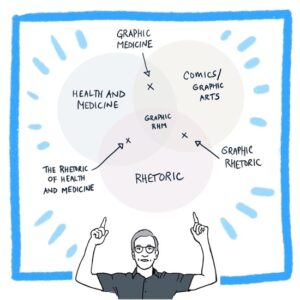 pages or 9 panels). We are open to considering publishing excerpts of longer comics and to publishing multiple excerpts over several columns as part of a series. Submissions can also be shared with us at any stage of development (including thumbnail sketches, storyboards) and can even be a set of multiple related, shorter comics (e.g., about the same experience).
Comic submissions should include alt text and any audio components should be accompanied by a transcript. We welcome other ideas for making published content more accessible as we work on making the column as accessible as possible to all interested readers. Two of the contributors to the inaugural column, for example, developed an audio track that mixes voice and music for each panel of the comic (Dozier) and multiple ways of viewing/reading/listening to the comic (Bahl).
The artist statement should provide a brief explanation of the comic’s exigency, creation process, and/or context, along with its implications for the RHM audience; it should end with a bulleted set of “takeaways” for an RHM audience. The artist statement can be written, recorded as a sound file, and/or drawn as a comic (see examples of the latter by Al-Jawad and by Weaver-Hightower). The written portion of the artist statement should be no longer than 1500 words. Contributors who do not identify as rhetoricians of health and medicine may get help from the column co-editors or other rhetoricians with portions of their artist statements.
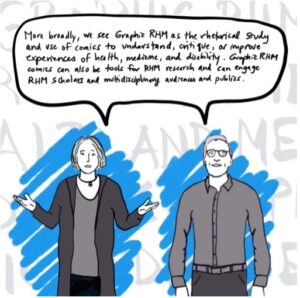
Exploring the Graphic Medicine/Rhetoric of Health and Medicine intersection, we hope this “Graphic RHM” column will extend our field’s trans/interdisciplinary reach and enrich its practices, including those related to theorizing, research, teaching, and outreach. To this end, we invite the following types of submissions and ask that interested scholars propose new types:
 Comics about equity and justice in health and medicine;
- Testimonials of health/medical experiences (as patients, caregivers, providers, etc.);
- Sociocultural commentary on historical or contemporary health or medical rhetorics;
- Health advocacy comics;
- Patient or provider education comics;
- Public health and public health policy comics;
- Comics about teaching tools, heuristics, or assignments;
- Representations of ethical concerns or conundrums;
- “Translational” comics that make rhetorical/RHM work more visible and accessible to other specialized audiences or wider publics (e.g., comic forms of RHM theories or findings);
- Comics about methodologies (including their affective and sensory dimensions), including tools, forms of data collection, data visualization and/or analysis, and methodological concepts; and
- Comics about partnership-building with health and medical stakeholders, communities, and publics.
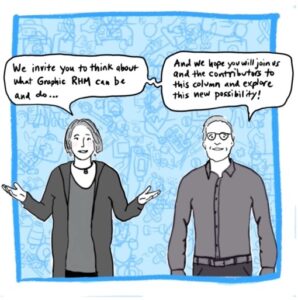
The column co-editors may sometimes issue more specific calls for types of comic submissions, including those that will allow the column to align with special issues of the journals and to experiment with developing comic versions of concepts, methods, or arguments developed in published rhetoric of health and medicine scholarship. We also encourage discussion with us about guest-edited columns coordinated around topics of interest and importance to the RHM community.
 Folks just getting started with comics may want to check out the work of Lynda Barry (e.g., Making Comics), Allie Brosh (e.g., Solutions and Other Problems), Ivan Brunetti (e.g., Cartooning), and Scott McCloud (e.g., Making Comics). For an introduction to the movement of Graphic Medicine (and examples of comics about health and medicine), see the websites of the Graphic Medicine International Collective, National Library of Medicine’s Graphic Medicine exhibition, Annals (of Internal Medicine) Graphic Medicine, the AMA Journal of Ethics special issue on Graphic Medicine and Health Care Ethics. See also rhetorician Jenell Johnson’s Graphic Reproduction: A Comics Anthology. If you are a rhetorician interested in developing comic versions of your work but would like help, the column co-editors might be able to connect you to someone more experienced with comics (as a potential co-author).
Submissions will be peer reviewed unless by mutual agreement between the authors and editors, and comics published in the journal will be copyrighted by the University of Florida Press and by Creative Commons CC BY-NC-ND 4.0 license.
Contributors should submit a google folder containing:
- Each panel of their comic as an individual a jpg (these should not be images inside a word or google doc)
- Their full comic as a pdf (either one panel per page or multiple panels per page – however they’d like to see it). If they know how to add alt-text to a pdf, that would be very helpful to do.
- A word or google doc of alt-text for each individual panel
- A word or google doc with artist statement (if images are included, they can be included as inserts in the doc, but should ALSO be in the folder as separate jpegs, and alt text will be needed for those as well)
- Minimum dpi for images = 400
- All images should be submitted for a portrait 8½”x11” orientation, 1” margins (you can decide how many images are on one page and the orientation in columns, etc, but use a standard size Word document for formatting as you imagine graphic size)
Submissions and queries should be sent to co-editors Catherine Gouge and Blake Scott at GraphicRHM@gmail.com. We are happy to meet with potential contributors to discuss ideas, and we’ll continue to create forums for those interested in Graphic RHM to explore how to use comics in their rhetorical work.