
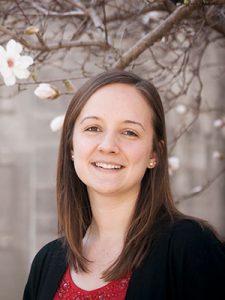
 Title: Assistant Professor of Rhetoric and Composition
University: University of Wisconsin-Milwaukee
Email: bloompoj@uwm.edu
Twitter: Rachel_Bloom
Website: N/A
Description of Work:
I’m a qualitative, bilingual researcher who cares about improving healthcare for marginalized communities and examining how language, culture, and race influence health communication and care for patients. I advocate for community and patient discourses of health (often referred to as lay terminology) as an important area of study and something that is of equal importance to provider discourses of health (aka “professional” medical terminology). My current scholarship draws from an ethnographic study I conducted with a summer health program in the Dominican Republic. I examine how U.S. and Dominican participants responded to linguistic and cultural differences in how they spoke Spanish, discussed medical terms, and worked together to run temporary health clinics. In my forthcoming monograph, The Rhetoric of Translanguaging, I use this study to argue for a rhetorical approach to translanguaging (García and Wei) that 1) complicates language ideologies to challenge linguistic inequality (and notions of “good” or “bad” language); 2) cultivates translation spaces across modes, languages, and discourses; 3) draws from collective resources through relationship-building; and 4) critically reinvents discourse between institutions and communities. I’m also starting a new project with Laura Gonzales, and we will be discussing it at the symposium. We plan to explore how medical translators respond to language variation with the Spanishes they encounter in their work with patients, and what rhetorical tactics they use to move forward in translations when there are differences in languaging or when they might have concerns about health literacy and the medical terminology used. I also hope to return to the Caribbean/Latin America in the next year to start a new project with community health leaders who work with, and host, health providers and visitors from other countries. I’m interested in learning from their experiences of advocating and caring for their communities’ health in relation to broader discourses of global health.
Symposium Submission:
Rhetorical Inquiry with Medical Translators in Latinx Communities
Purpose
During the summer of 2017, we will be conducting research with 20 medical interpreters working with Latinx communities at the Hispanic Center of Western Michigan in Grand Rapids. We anticipate the 2017 Symposium for the Rhetoric of Health and Medicine to be an ideal forum for us to share the initial findings of our study and solicit feedback as we prepare a “Dialogue” piece for the new journal, Rhetoric of Health and Medicine. This piece will include medical practitioner voices in a discussion about how language diversity both complicates and facilitates ethical medical care in marginalized communities.
Project Background
Caring for the health of Spanish-speaking immigrants from Latin America who have limited English proficiency (LEP) presents a number of challenges for health providers who have limited Spanish proficiency (LSP). Cultural and linguistic differences often influence how patients and providers discuss and understand concepts of health and illness. This leads to a number of high stakes implications for the lives and well-being of LEP patients seeking care in predominantly English-speaking clinical settings, as “patient LEP status has been associated with longer hospital stays, increased risk of medical errors and misdiagnosis, worse control of diabetes, and less satisfaction with clinical care” (Tang, et. al 1784). In turn, studies have also shown that the use of professional interpreters and culturally sensitive approaches can benefit the patient experience with the U.S. healthcare system (Jackson, et. al; Shi et. al).
As the number of immigrants from Latin America has increased in cities across the U.S., the presence of Spanish-speaking medical interpreters has also increased. The roles of interpreters have also been examined in regard to provider and interpreter expectations, investigating whether interpreters should act as an “invisible” conduit of language, cultural broker, collaborator, or agent meant to intervene in other ways (Hsieh; Dawson et. al; White and Laws). Existing studies on translation with Spanish-speaking patients have established that miscommunications “occur among patients and interpreters who learned Spanish in different countries, as accents and vocabulary vary across Latin America” (Brooks et. al 31). Additionally, interpreters and translators may not be familiar with the specific language about certain specialties and diseases being discussed (Joseph and Guerra). Professionally trained medical interpreters have been deemed the necessary standard for providing high quality care for LEP patients, as opposed to ad hoc interpreters or family members (American Medical Association, 2015). However, this focus on professional training may emphasize “standard” language use in a way that disregards variation in patient discourses and literacy levels. Additionally, while Spanish-speaking patients may come from a variety of countries and cultural backgrounds, health literature tends to describe them as a homogenous group. With a patient population that may represent many different countries, regional dialects of Spanish, and cultural contexts, current discussions of cross-cultural health communication and translation must account for the complexity of interpreting across various forms of Spanish, English, and medical terminology for Spanish-speaking patients classified as LEP.
As the Rhetoric of Health and Medicine continues to solidify its identity as a field, we argue that research should focus on the role of rhetoric in the complexity of multilingual health care today. Therefore, our project demonstrates how medical interpreters and translators can serve as important collaborators for inquiry into care for patients from diverse cultural and linguistic backgrounds.
Methods and Potential Implications
In order to better understand how medical interpreters facilitate communication between English-speaking health providers and Spanish-speaking patients, we will be interviewing and shadowing 20 medical interpreters who work in various hospitals in the Grand Rapids, Michigan area. We will conduct individual interviews with interpreters (lasting about 1 hour each), in addition to holding 2 small group focus groups where interpreters can collectively discuss their approaches to medical interpretation in their community. Finally, we will shadow medical interpreters as they facilitate consultations across 3 area hospitals during a 4-day period. In this way, we will be able to both discuss and briefly experience the roles that medical interpretation and language diversity play in health care for Latinx communities in Grand Rapids, Michigan.
Our study will aim to answer the following Research Questions:
1) What are U.S. medical Spanish interpreters’ experiences with language variation and notions of “standard Spanish” in their work?
2) How do professional medical interpreters use rhetorical strategies in how they choose words and gestures with patients and providers?
3) How do medical interpreters respond to perceived differences in understanding or shared vocabularies?
4) How do medical interpreter training programs influence the ways that professional interpreters approach language and cultural difference with Spanish-speaking patients?
Cultural values and preferences shape how interpretation functions. The ways that interpreters respond to language variation among Spanishes can influence whether the language of the patient is being heard and understood, thus influencing the patient’s subsequent experiences with diagnosis, follow-up, and navigation of the healthcare system. Because both of us have training and experience in medical interpretation across Spanishes and Englishes, this study will provide additional context and evidence for our broader work in language diversity and medical interpretation. Importantly, this project will also help us a develop a poly-vocal article that grounds discussions of rhetoric and medical interpretation in the experiences of practicing interpreters working to improve health care in their communities. At the 2017 Symposium for the Rhetoric of Health and Medicine, we will share a draft of our article to solicit feedback, in addition to sharing visual and written data narratives that center the voices of Latinx medical interpreters. This data will include video and audio footage, participant-designed diagrams and visualizations, as well as written artifacts collected during our medical interpretation shadowing period. In this way, our presentation at the symposium will provide an interactive space for attendees to consider both how medical interpretation influences health care and how we as rhetoricians can ethically and intentionally include participant and practitioner perspectives in our work.
References
American Medical Association (2015). Nondiscrimination in healthcare activities. Retrieved from https://www.regulations.gov/document?D=HHS-OCR- 2015-0006- 0840.
Brooks, K., Stifani, B., Ramírez Batlle, H., Aguilera Nunez, M., Erlich, M., and J. Diaz. (2016). Patient perspectives on the need for and barriers to professional medical interpretation. Rhode Island Medical Journal (January 2016). 30-33.
Dawson Estrada, R., Reynolds, J.F., and D.K. Hilfinger Messias. (2015). A conversation analysis of verbal interactions and social processes in interpreter-mediated primary care encounters. Research in Nursing & Health 38: 278-288.
Hsieh, E. (2009). Bilingual health communication: Medical interpreters’ construction of a mediator role. Communicating to Manage Health and Illness. Eds. D. E. Brashers and D.J. Goldsmith. Routledge. New York: NY: 135-160.
Joseph, G. and C. Guerra. (2015). To worry or not to worry: breast cancer genetic counseling communication with low-income Latina immigrants. Journal of Community Genetics. 6: 63-76.
Shi, L., Lebrun, L.A., and J. Tsai. (2009). The influence of English proficiency on access to care. Ethnicity and Health. 14(6), 625-642.
Tang, A.S., Kruger, J.F., Quan, J., and A. Fernandez. (2014). From admission to discharge: Patterns of interpreter use among resident physicians caring for hospitalized patients with limited English proficiency. Journal of Health Care for the Poor and Underserved 25: 1784-1798.
White, K. and M. Barton Laws. (2009). Role Exchange in Medical Interpretation. Journal of Immigrant Minority Health 11: 482-493.