
 Title: PhD Fellow
University: University of Copenhagen
Email: mathias.moellebaek@sund.ku.dk
Twitter: mathiasmlbk
Website: mathiasmlbk.wordpress.dk
Description of Work:
I work with rhetoric in the context of regulation of medicines and I am fairly new at this; 8 months into a three-year PhD research project. At this early juncture (and in my symposium submission), I wonder about what “interdisciplinary” means. So, I am very interested in the research politics and disciplinary/epistemological calibration practices of collaborating with health scientists and working across rhetoric and health sciences. This interest is central to my own education as a researcher, naturally, but I would argue that the current changes in research funding and institutional prioritization of communication disciplines warrant a more extensive scholarly discussion of interdisciplinarity, both its project-based and more permanent forms.
I am currently employed at the Copenhagen Centre of Regulatory Science (CORS) to do a three-year PhD research project on regulatory communication to healthcare professionals about newly found risks in drugs, which are already approved and on the market. The primary audience for this research is regulators in health authorities and regulatory professionals in industry, and secondarily academics in regulatory sciences. And to mark the trans-science character of the project, a representative from The Danish Medicines Agency and a representation from regulatory affairs in industry are both onboard as advisors on the project in addition to academic advisors from sections of social pharmacy and rhetoric.
The project is firmly rooted in an empirical health and behavioral science paradigm. But I come into this project having worked a lot with post-structuralist perspectives on rhetoric, rhetoric of science and public science communication. So, I am currently exploring STS and new materialism literature to find fruitful connections and new critical perspectives.
Symposium Submission:
The Practice and Politics of Interdisciplinarity in Rhetoric of Health and Medicine
Per definition, interdisciplinary research collaborations across human and health sciences multiply each aspect of the research practice, suspending each element of research between alternatives. With (at least) two disciplines involved, there will always be more than one view on ontology, epistemology, methodology, the use of theory et cetera. Consequently, each turn in doing the research involves an act of calibration between multiple alternatives. To cast rhetoric of health and medicine as an interdisciplinary field I am aware that I limit its scope to the interface between research traditions. However, I will argue that this interface is very important to rhetoric of medicine and health as a nascent field because of the epistemic and political presuppositions that typically govern this interface. Interdisciplinarity may signify the successful integration of disciplines fruitfully producing hybrid forms of knowledge or it may describe a governance instrument which situates scholars with “emancipatory research interests” in large research schemes with overriding “technical research interests” (Habermas 1971).
So, although anchored in a research project on medical rhetoric, this article does not present work on the rhetoric of health and medicine as such. Instead, I will examine some of the conditions for doing rhetorical studies in health and medicine, specifically the practice of interdisciplinary research in the context of current European research politics. The purpose is, first, to understand the immediate, practical conditions of adopting an interdisciplinary attitude which, to use Debra Hawhee’s description, attempts “to suspend – however temporarily – one’s own disciplinary terms and values in favor of a broad, open, multilevel inquiry…marked by shared interest in a particular matter or problem” (2009, 3). The second purpose is to understand the political epistemology that undergirds such aspirations. Interdisciplinary research is weaved together with power relations afforded by the differences in currency of epistemologies and methodologies. This circumscribes the agency that any interdisciplinary rhetorician may have in the context of health and medical research.
The locus of the article is my own 3-year interdisciplinary and trans-scientific PhD project. It is interdisciplinary as it involves both rhetoric, social pharmacy and regulatory sciences of medicines, and it is trans-scientific as it includes stakeholders in industry, government authorities and academic research. I have supervisors from the Danish Medicines Agency, the pharmaceutical industry and from the section of social pharmacy and the section of rhetoric at the University of Copenhagen. The topic of the PhD project is the optimization of drug risk communication to physicians on a European level, so it, simply put, investigates a certain form of communication within the field of pharmaceutical regulation. It is the first of a number of interdisciplinary PhD projects at the newly opened Copenhagen Centre for Regulatory Sciences.
For this article I will conduct a focus group interview with the project supervisors and semi-structured interviews with interdisciplinary scholars in related fields. The purpose of the focus group interview is to map and analyze the positions that the different supervisors may take in regard to the interdisciplinarity of the project. The interview and analysis will revolve around a typology of interdisciplinary ‘trading zones’ (Collins et.al. 2007. See Ill. 1), which extrapolates Peter Galison’s observation that successful interdisciplinary research collaborations establish hybrid discourses to make up for the lack of a shared, “natural” disciplinary terminology – analogous to historical trading practices between merchants from different cultures (Galison 1997).
Additionally, I will interview senior scholars in social pharmacy originally from anthropology and sociology and one PhD student with a background in pharmacy now working in anthropology. The purpose here is to collect experiences of interdisciplinarity from related scholars and, in particular, probe the political aspects of interdisciplinarity: How has it developed over time and how it has influenced their work across disciplines?
The data from the interviews provides the basis for two interrelated discussions about the practice of interdisciplinarity for rhetoricians in health and medical sciences and the political epistemology underpinning it. Discussions of interdisciplinarity among rhetoricians have mostly appeared in rhetoric of science fora. A 2013 symposium on rhetorical scholars’ work in technical and health sciences revealed a remarkable variation in approaches to interdisciplinary research collaborations as well as emphasized the importance of a discussion of the definition of rhetoric in this context (Ceccarelli 2014; Druschke 2014; Goodwin 2014; Parks 2014; Rief 2014). The focus group interviews will give insights to what the perceived role of rhetoric is in the specific research project I am conducting and what kind of interdisciplinarity this role presupposes. Is the rhetorical contribution constitutive of the project or is it more auxiliary? This will also add to the current discussion of the rhetorical scholar as “embedded” (Ceccarelli 2014). This is a prevalent notion but not unproblematic as it suggests that disciplinary identity is somewhat fixed and immutable.
In addition to the practices of rhetorical researchers, these questions relate to current research politics, specifically in a European context. As of 2011, the idea of interdisciplinarity has become very central to the world’s largest research funding program, the Horizon 2020 in the European Union. It now grants funds not addressed to singular disciplines but to so-called “grand challenges” (European Commission 2011). The rationale is that academic research should contribute to solving the overarching challenges in society, which entails a complexity that exceeds the conventional matrix of disciplines. Furthermore, this implies that academic research needs to be organized as large projects – often institutionalized in research centers – and focused on products, solutions and/or patents to be utilized by users outside of academia (Budtz Pedersen and Collin 2015). These problem- and project-orientated conditions of research pose numerous questions about the position of rhetoric as a discipline in the politics of interdisciplinarity. The interviews will produce tangible input for a discussion on what rhetoric may be in this political setting.
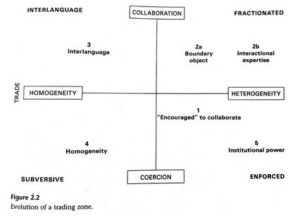
III. Interdisciplinary trading zones
Literature
Budtz Pedersen, D., & Collin, F. (Eds.). (2015). Kampen om disciplinerne : viden og videnskabelighed i humanistisk forskning. Kampen om disciplinerne. Hans Reitzels forlag.
Ceccarelli, L. (2014). Where’s the Rhetoric? Broader Impacts in Collaborative Research. Poroi: An Interdisciplinary Journal of Rhetorical Analysis & Invention, 10(1), 1–9. https://doi.org/10.13008/2151-2957.1182
Collins, H., Evans, R., & Gorman, M. (2007). Trading zones and interactional expertise. Studies in History and Philosophy of Science Part A. https://doi.org/10.1016/j.shpsa.2007.09.003
Druschke, C. G. (2014). With Whom Do We Speak? Building Transdisciplinary Collaborations in Rhetoric of Science. Poroi, 10(1), 1–8. https://doi.org/10.13008/2151-2957.1175
European Commission. “From Challenges to Opportunities: Towards a Common Strategic Framework for EU Research and Innovation funding.” Com (2011), 1–15. https://doi.org/Brussels, 9.2.2011 COM(2011) 48).
Galison, P. (1997). Image and logic : a material culture of microphysics. University of Chicago Press.
Goodwin, J. (2014). Introduction: Collaborations between scientists and rhetoricians of science/technology/medicine. Poroi, 10(1). https://doi.org/10.13008/2151-2957.1176
Habermas, J. (1971). Knowledge and Human Interests. Boston: Beacon Press.
Hawhee, D. (2009). Moving bodies : Kenneth Burke at the edges of language. University of South Carolina Press.
Rief, J. J. (2014). Building the Case for an “Architectonic” Function of Rhetoric in Health Services Research. Poroi, 10(1). https://doi.org/10.13008/2151-2957.1180
Parks, S. B. (2014). Is There Room for a Student of Rhetoric in a Giant NSF Grant Project? Poroi, 10(1). https://doi.org/10.13008/2151-2957.1177