
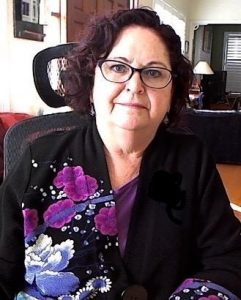
 Title: Chair, Women’s & Gender Studies
University: University of South Florida
Email: priceherndl@usf.edu
Twitter: dphphd
Website: http://wgs.usf.edu/faculty/dherndl/
Description of Work:
I work at the intersection of several disciplines: feminist theory, the study of American cultural productions, medicine, and disability studies. I have long been interested in the ways that a medicalized view of the body shapes not just our perceptions of other peoples’ bodies, but of our own. I started working on American novels of the mid-nineteenth century that had plots centered on women’s illnesses, but I have—in the 30 years I’ve been working on this question—ended up branching out to lots of different texts (ads, science fiction film, advice books, and photography to name a few). The questions I ask have to do with how those texts use, invoke, or create a techno-scientific (or pseudo-techno-scientific) discourse to enframe bodies. My courses often focus on non-standard bodies: technologically enhanced bodies or bodies with disabilities or illnesses.
My scholarship has focused on the cultural discourses of breast cancer, both artistic discourses like autobiography, novels, poetry, and art, and public discourses like Supreme Court decisions, advertising, and pink-ribbon campaigns. I’ve grown interested in advice literature, especially so-called cancer prevention advice and anti-obesity writings (these two are often conflated). This path has led me to examine feminist ethics in the context of rhetoric, interrogating the ethics of representation in relation to life-threatening illnesses and within a system of capitalism, where health becomes a consumer product.
My project for this symposium examines the rhetorical ethics of mastectomy photography. In less than two decades, mastectomy photography has gone from a clinical form of documentation, to feminist activism, to alternative health practices, and finally to large gallery installations. I ask what kind of work such photography does in the world, a question that is, of course, entirely rhetorical.
Symposium Submission:
Witnessing the Post-Mastectomy Body: Revulsion, Recognition, and Rhetoric
In Witnessing: Beyond Recognition (2001), Kelly Oliver asserts that “witnessing” involves being an eyewitness as well as providing testimony and argues that we become subjects only in conversation with others, in what she calls “response-ability.” Such response-able relationships are a form of interdependence without subordination in which we become subjects both in response to others, and in allowing them to respond to us. This creates, she argues, an ethical obligation: talking to others in such a way that we elicit response and listening to others in such a way that we accept their responses. Oliver’s work provides a context for my examination of photographs of the post-mastectomy body. Those visual images were once the province only of medical texts, but in recent decades have become public art, shown in museum galleries, local bookstores, and even on bus shelters and billboards. While many images present that body with sympathy and pride, others offer the post-surgical body to shock. My paper offers a theory of visual feminist rhetoric to understand how photography of post-cancer bodies works to “witness” to the realities of the ill or disabled body.
Such photographs may work to force public recognition of the reality of breast cancer, and may also connect women with the disease, in much the way that Audre Lorde had in mind when she urged making breast cancer visible in The Cancer Journals. But the deliberately shocking images, sometimes sprung upon an unwary audience, may create not sympathy but revulsion, not an understanding of disease as an ordinary facet of life, but a sense of cancer as trauma, and the cancer patient as merely pitiable. How do we think about the rhetorics of empathy and shock? Using work from feminist theory and disability studies, I explore how we can come to a feminist visual rhetoric of witnessing of the diseased, disabled, or surgically altered body that is empathetic and “response-able.” This feminist rhetoric challenges traditional ways of describing the gaze as an instrument of power and control, suggesting instead that the gaze can work toward empathy and connection. Such a theory allows us to imagine a visual rhetoric of photography as pedagogy, communication, or storytelling. To illustrate these possibilities, I focus on several relatively coherent projects focused on post-mastectomy photography that come from different motivations and were presented in very different contexts, including Art.Rage.Us: Art and Writing by Women with Breast Cancer, The Scar Project, and the Bodies of Courage Project.