
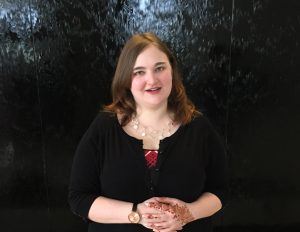
 Title: Graduate student; Assistant Director of Graduate Student Writing
University: University of Louisville
Email: caitlin.ray@louisville.edu
Twitter: ray_raycaitlin
Website: N/A
Description of Work:
I am a PhD student at the University of Louisville, going into my third year. I am preparing my dissertation prospectus (a draft of which I will be providing for this symposium). I will be defending the prospectus in November. I consider my primary area of research and scholarly work in both disability studies and medical rhetoric, and my current area of inquiry is about the ways that people with chronic illness and pain are both portrayed in narrative and how they are impacted by such representations. Additionally, I am interested in how public policy and rhetoric impacts this community. In this current study, I am also exploring ways to incorporate arts-based methods to both collect and represent data. I am also doing research on disability rights activists, and am considering how the understanding of disability as an identity impacts the ways that disability itself is discussed in public spaces.
Symposium Submission:
Empowering the ‘Wounded Storyteller’: Arts Organizations, Health Policy, and the Healing Public
The Rhetoric of Health and Medicine is continually positioning itself between the work in the Rhetoric of Science and Technology and humanities-oriented fields, like medical humanities. In this debate, I take the position of Lynch and Zollar who argue for “drawing from an array of research methods” in order to strengthen our disciplinary position and allow ways to interact and advocate for the communities that our research affects (502). My research intersects both the Rhetoric of Health and Medicine and arts-based research, and within this work, I hope to attend to the call outlined by Keränen in the Journal of Medical Humanities to “understand how citizens, institutions, and movements increasingly organize around biological, medical, and health matters” and to find ways in which to examine how the public interacts with the “socio-cultural, ethical, aesthetic, and historical dimensions of health and medical practice” (105). In order to do this, I intend to study how arts organizations who work within communities around health initiatives do their work, and how this type of arts and health activism can be discussed through the lens of rhetorical theory.
In considering the ways that critical analysis informs our rhetorical work, I also want to reflect how feminist and disability studies influence my own methods and analysis, primarily in considering the call in disability studies for “nothing about me without me.” This call is incredibly important in the Rhetoric of Health and Medicine, where we discuss matters that have real, material consequences for (often disenfranchised) patients. My own interest in the connection between patients, doctors, and the arts is underpinned by my previous research in the phenomenology of pain and chronic illness, particularly in populations that are historically disenfranchised in medical settings (including, but not exclusive to, women, people of color, and people with disabilities). I am also interested in how power structures that often medicalize or undertreat pain and illness in certain populations can be dismantled, and so hope to contextualize the research gathered from this project into larger notions of the experience of illness within society. By collecting and articulating narratives of patients, of artists and organizers, I hope to make explicit the “beliefs, values, and assumptions” of their experiences (Merriam 34).
Thus, in my preliminary analysis for my dissertation, I plan to examine the growing trend of arts organizations partnering with health initiatives within specific communities. Louisville, Kentucky is currently an ideal place to undertake such research, as one of the four cities in the US to receive the 2016 Robert J. Wood Culture in Health Prize. This prize recognized Louisville’s attempts to rectify historical inequalities that lead to health disparities in the community, and one of the results of this prize was the development of the emerging arts organization “Project H.E.A.L.” Project H.E.A.L, an organization started and developed by the IDEASxLab and Creative Agents of Change (a nonprofit that studies the role of creativity in health and well-being), seeks to “create equitable places and nurture healthy communities,” and primarily does this work through artistic interventions (“About”). In addition, I want to look at other organizations (not necessarily in Louisville) doing this work, including the Kentucky Center for Arts and Healing, an organization focused on connecting the local arts scene to healthcare providers, and the Cleveland Clinic Arts and Medicine Institute—a program devoted to integrating the arts into the health and healing of their patients. All use arts-based action research to develop health literacy and heal health disparity, and all employ these methods with artists and work with either the patient or medical community. They also argue for ways that this work can go towards articulating and advocating for specific health policy.
In my research, I plan to analyze how these arts organizations communicate with and to the communities they work within. I am interested, for instance, in how these organizations select and train artists to work within specific communities, and whether these types of interventions are successful. For example, are patients better able to articulate their health experiences after working with these arts organizations? Are these organizations able to help patients find ways to communicate and advocate for themselves and their health? Such questions help me articulate how the arts organizations that partner with health initiatives go about interacting with their respective communities, and whether these partnerships are successful.
Additionally, and perhaps most importantly for the work I hope to bring to the symposium, I intend to examine the ways that these arts organizations think about and discuss the intersections of health, illness, and community in health policy. The organization Artseverywhere articulates their view on the use of the arts in the development of health policy, asking, “ Can artistic/aesthetic practice help us to re-integrate, re-inform, and re-imagine solutions that consider broader, more collaborative approaches to health and policy?” This claim is what interests me about such arts organizations, and I hope to examine this claim within them. These arts organizations argue that, as a result of their advocacy, the broader public can have more input in health policy in a “bottom-up” approach. My study is therefore interested in how such change is discussed and enacted within specific communities.
Over the summer, I will be undertaking preliminary interviews and data collection of arts organizations and their interactions within specific communities and resulting discussions of health policy. My hope is to have a draft of my dissertation prospectus by August, in which I will outline more fully my methods and arguments. However, one thing I know is that I want this project to represent my positioning in the field of the Rhetoric of Health and Medicine and my interest in how the arts can be used as a way to connect to specific communities. By examining how arts organizations employ arts-based methods through rhetorical analysis, I will be able to examine the strategies that these organizations use to bring the stories and experiences of specific communities to the ways that health policy is articulated and ultimately enacted.
Works Cited
“About.” IDEASxLab. http://www.ideasxlab.com/about/. Accessed on 12 February 2017.
Artseverywhere- Musgates. “A Re-imagination of Policy and Health: Towards the Creation of an Arts/Health/Policy Nexus.” World Policy Initiative. PDF.
Keränen, Lisa. “Public Engagements with Health and Medicine.” Journal of Medical Humanities, vol. 35, 2014, pp. 103-109. DOI 10.1007/s10912-014-9275-7
Lynch, John and Heather Zollar. “Recognizing Differences and Commonalities: The Rhetoric of Health and Medicine and Critical-Interpretive Health Communication” Communication Quarterly, vol. 63, no. 5, 2015, pp. 495-503, DOI: 10.1080/01463373.2015.1103592
Merriam, Sharan. “Types of Qualitative Research.” Qualitative Research: A Guide to Design and Implementation. Josey-Bass, 2009.
“Project H.E.A.L.” IdeasxLab. http://www.ideasxlab.com/proj-heal. Accessed 12 February